

Back issues
No 1664 15th October 2025
Trump’s laughable “peace plan” for Gaza a giant confidence trick offering only humiliation to exhausted and traumatised Palestinians. But it is still imperialist retreat to rescue an increasingly fraught Zionist occupation of Palestine & take momentum out of the worldwide hostility and hatred for its disgusting and sadistic genocide. The US has to rein in the increasingly desperate belligerence of the fanatical Netanyahu cabinet which threatens wider US interests by its wilder lashing out against the Gulf sheikhdoms, a problem Washington can do without as world turmoil is growing explosive on Palestine and against slump tyranny everywhere. Third world protests and riots threatens to merge with anti-Zionism, and with US domestic conflict which can only push world masses closer to revolutionary sentiment. And this can only get much much worse as credit-deferred Catastrophic economic breakdown implodes in share price chaos and imminent collapse of the dollar (another black October). Marxist-Leninist revolutionary science must develop, to guide the existential class struggle as the REAL slump unfolds
For all the “cheering crowds” in Jerusalem and Trumpite “peacemaker” bragging in Egypt’s Sharm el-Sheikh summit, the underlying reality of the new “era of peace” for Gaza is as much one of setback for the monstrous Zionist colonial occupation of Palestine as it is for the exhausted and traumatised Gazans.
Ditto for the imperialist West which funds it, arms it and otherwise props it up with direct military and intelligence backing, as nasty as anything done in war-crime and torture saturated Iraq, Afghanistan or the Ukraine front lines, and hundreds of imperialist wars before.
Of course the shallow detail-free “deal” is a sick joke carried out by the very monsters who have perpetrated the last two years of horrifying depraved genocide, the Zionist occupiers and their backers.
And under the current crisis-wracked world order it certainly cannot and will not produce an “end to wars” in the Middle East and new prosperity, not now, not in the long term and not ever, as everyone above moron level intelligence understands, and none more so that the butchered, tortured and bereaved Palestinian population themselves who would see little of any risibly boasted “Golden future” even if it could possibly come to pass, which it cannot in the hurricane of oncoming world capitalist economic Catastrophe.
Far from building yet more sick unsustainable parody cities like Dubai on the Gaza coast, the whole world’s future is one of devastation everywhere as B52s intimidate off the Venezuelan coast and Europeans escalate demented bogeyman hysteria against Russia and China.
Even if the Zionist signatories to this pantomime “accord” could be trusted to hold the ceasefire for more than five minutes – they cannot, as twice shown before, and even this time with another dozen shot dead already, and demonstrated further by endless daily, even hourly, violent Israeli infringements of the broken UN “truce” with Hezbollah in bordering Lebanon – the future under this deal is one of total continuing humiliation and dispossession for the people whose country has been stolen away from them for the last hundred years, by trickery, by international “United Nations” partition diktat, by terror-gang expulsion and by outright war and annexation.
And until that is returned to them, the lands, the cities, the villages, the farms, the orchards, the wells and the olive groves not with a contemptuous token “2-state” gesture, giving them just 22% of what is all rightfully all theirs, but in total as far as can be done, there can be no peace at all – unless they are wiped out almost utterly like the 200 indigenous nations of America (Incas, Iroquois and Inuits etc) or the Aborigines in Australia.
Even if politicians’ mouthings about “recognition for a Palestinian nation” were more than cynical hypocrisy, as far as freedom and self-determination is concerned the deal is nothing but a total huckster confidence trick by imperialist world domination played on the barbarically butchered and tortured Palestinian masses who will see no end to their suffering agony and bereavement while capitalism continues to rule the world.
The “self-rule” and future development they are “offered” (mafia “can’t refuse” style) is one of complete subjugation, with every option for their own decision ruled out, and the “greater powers” arrogantly banning any representation and leadership of their own, most of all by resistance forces like Hamas (despite them having won an election in 2006 for Gaza which has never been honoured by the “democracy-upholding” Western imperialist world) and, as far as Tel Aviv is concerned, not even the grovelling stoogery of the Abbas Palestinian Authority.
Instead colonial overlordship is to be imposed chaired by the monstrous war criminal Tony Blair, virtually a re-run of the “British Mandate” which led to all the trouble in the first place but this second time around, as Marx famously said, repeated as farce, in thrall to US imperialism and its Zionist regional rottweiler.
Even less will it deliver any respite at all in the much larger remainder of Palestine, the West Bank and East Jerusalem, where fanatical fascist “settler” persecution, house demolitions, well-poisoning, farm and village destruction, armed bullying abuse, beatings, killing, torture and intimidation continue, untouched by the “peace deal” and mostly unreported by the craven Western media and ignored or even supported by imperialism’s politicians, not least the US itself and its just as fanatically barmy-fundamentalist “Christian” ambassador, Mike Huckerbee.
It is not even clear the initial ceasefire that the Gazans have been bullied into agreeing (via the craven collusion with imperialism of the corrupt and degenerate Arab-monarchist and Muslim-oriented bourgeois nationalist regimes like Erdogan’s Turkey) will last more than transiently.
But the Palestinians are still there after two years when it was predicted they would be wiped out in just two months after the October breakout, and their resistance is still intact, even growing in numbers as eager recruits replace those killed by the Zionist occupation.
And for the moment there is even some relief from the non-stop blitzing, massacres of hundreds of thousands of civilians, men women and children, (the real count, not the deliberate understatements by the bourgeois media), the gross terrorising drone assassinations and sniper killings of random victims, the vicious deliberate targeting of doctors, journalists, aid workers and educators, the horrific kidnappings, and incarcerations seizing, holding, beating and torturing thousands without charges, as well as the ruthless and demented destruction of all life-sustaining infrastructure, cultural and historical structures and even the rich regional ecology itself.
Some 2000 prisoners, in fact mostly uncharged and barbarically treated captives – hostages as they would properly be called by an unbiased media – are released in exchange for the few Israeli Zionists who are almost exclusively focused on by the bourgeois media (bar one or two “liberal” exceptions) for endless overplayed one-sided propaganda sentiment stories.
The people’ resistance remains standing and as even a few bourgeois press accounts have grasped the consequences will reverberate through history:
This is not the end of the story – the deeper struggle for rights and dignity remains.
Some two hours after a ceasefire came into effect in the battered, besieged Gaza Strip, many of us watched – live on air – Israeli tanks bombing Palestinians near al-Rashid Street, the last open route for residents of southern Gaza to reach the northern part of the coastal enclave.
The scenes of dozens of people fleeing for their lives as smoke billowed amid a wasteland of rubble, caught by an Al Jazeera camera, were a horrific reminder of past ceasefire agreements broken by Israel. The last of these being on 18 March, when it struck Gaza, killing hundreds of Palestinians even after it violated the terms by hindering and limiting entry of aid to the famine-struck population.
Time will tell whether this ceasefire represents real change or if it is merely a tactical performance –another extension of war by other means. It seems more likely Israel will use this pause to bring itself some respite from the continuing global outrage and pressure, and redirect attention, only to continue its actions once international focus fades.
This is why the Palestinian struggle has never been solely about stopping atrocities; it is, at its core, a fight for liberation. For many, this moment is not one for complacency, but for continuing the work that Palestinians in Gaza, the West Bank, and in the diaspora, as well as supporters all around the world, started years ago.
Flotillas must continue to sail to break the draconian siege imposed on Gaza since 2007. Students must resume their sit-ins at universities and colleges. Journalists must persist in demanding access to Gaza to cover war crimes. Demonstrators must carry on with flooding the streets.
These individual and group acts of resistance are part of what forced US President Donald Trump’s hand. He didn’t act on principle – he was cornered. A worldwide protest movement for Gaza had driven Israel into unprecedented isolation and left Washington diplomatically stranded.
Mounting public fury, combined with warnings from Arab governments fearful of domestic unrest amid Israel’s escalating violence, created unbearable pressure – especially after last month’s strike on Doha, the Qatari capital, intensified regional outrage.
Together, these pressures forced an outcome that could no longer be postponed: the genocide had to stop, at least temporarily, before Israel’s isolation became total and the region’s balance of power was reshaped beyond repair.
Gaza’s children can and should celebrate the end of one of the cruelest recorded genocides in recent history. They can sleep without the agonising hum of Israel’s drones bleeding into their ears, without the fear of being bombed in their decrepit tents. They may actually dream of a better future, despite the odds.
Israel’s campaign has failed. It did not depopulate Gaza, nor did it destroy the Palestinian cause. Nearly every military and political objective set by the Israeli prime minister, Benjamin Netanyahu, has collapsed.
On the ground, Israel faces a strategic defeat – though it mistakes devastation for victory, counting ruins and casualties as its only metrics of success. Unable to prevail through force, Israel will now attempt to secure by diplomacy and coercion what it could not achieve through one of the most destructive wars of our generation.
•Dalia Hatuqa is an independent journalist specialising in Palestinian-Israeli affairs
Demonstrations and flotillas, with brave and sacrificing individuals putting their lives on the line obviously have helped force the current suspension of the most obvious atrocities and are part of a continuing struggle.
But like the anti-apartheid movement before, the anti-Vietnam war movement in America, or the support for the national-liberation struggle in Ireland’s north, while they add to it, their social-pacifism is not enough and in the end anti-revolutionary: they reflect the underlying revolutionary struggle of the Palestinians themselves, and that of the wider world.
It is for this that the imperialist system has had to step back from the demented scheme to totally eradicate an entire people by bombing, sniping, starvation, and deliberately caused disease, with its brutalised and sadistic attack-dog Zionist regime now more isolated than ever before.
Even Trump had to tell the psychotic Netanyahu cabinet that “you can’t fight the whole world” making clear that the real content of this sudden deal – just weeks on from threatening to “open the gates of hell” (again), – is to rescue the Zionist occupation persecutors, split, demoralised and more exposed as defeatable than ever before.
The Jewish occupation’s fascist barbarities, monstrous from the very beginning of this misnamed “war”, and for decades of blitzings and butchery before that, are now so reviled and detested that there is uproar in every part of the Middle East, the Arab and non-Arab Muslim World, the Third World beyond that and increasingly by every part of humanity not bent and distorted by venal class interest, greed, arrogance, and decadent power, including more and more in America itself, despite the powerful but diminishing influence of the Jewish-imperialist freemasonry intertwined with its billionaire ruling class.
The Zionist capacity to intimidate is being steadily shot to pieces, and despite the genocidal inhuman smiting on the Gazans, the terrorising damage and “clever” sneak blows inflicted on resistance supporting forces in Lebanon, on the Syrians, the Iranians and the Yemeni Houthis (with never a word from the West about these warcrime “terrorist” methods indiscriminately targeting or including multiple civilians) the underlying story is that the once “invincible” Zionist militarised state faces defeat from resistance all around.
That was already showing through the carapace of bluster and threats two months ago during the unprovoked so-called 12-day war on Iran, brought to a halt by the USA’s theatrical B2 bomber raid on Iran’s nuclear processing facilities, which far from reinforcing the Zionists’ regional bullying, rescued it from an increasingly desperate situation as the missile barrages from Tehran started to penetrate the defence systems and land on military and government targets.
Washington had no wish at that point to continually repeat that hugely expensive and complex operation, and perhaps unleash major war with Tehran, even when it was clear it had not completely destroyed the Iranian’s nuclear processing capabilities; the raid’s purpose was solely to paper over the obvious cracks opening in the Zionist regime’s military and society by forcing a de facto truce while maintaining an aggressive façade to cover it up.
Those exposed weaknesses of the Zionists would be multiplied tenfold without the duplicity and hypocrisy of the rotten monarchist/tribalist Arab nationalist rulers who have sat on their hands (and their piles of oil, gold and Western investments) throughout the two year onslaught, secretly hoping the Zionists might succeed in their “final solution”, to remove an “awkward obstacle” to their own corrupt collusion with the Western ruling class and its degenerate drug and drink, brothel and gambling lifestyle.
Only because these totalitarian reactionary-murderous thug sheikhdoms, monarchies and military dictatorships all sit on potential volcanoes of Arab street revolt themselves do they still pay lipservice to solidarity with their fellow Arabs, the Palestinians.
It is the danger that those brittle treacherous regimes might be toppled or pushed over that is one of the major elements in the sudden Trumpite intervention, hoping to take the momentum out of a mass hatred that could explode once again like the Arab Spring in 2011, threatening once more to end the imperialist grip on the whole region as it did then.
Only a combination of CIA/Zionist fostered counter-revolutionary coups (Egypt, 2013), attempted reactionary “colour revolutions” (Libya and Syria) dressed up as just more “democratic struggle” and all-out NATO invasion when the Western-initiated petty bourgeois anti-Gadaffi revolt failed to take off, kept the lid on that, as well as the token “reforms” suddenly being offered in the last decade in Saudi Arabia by the journalist-killer crown prince Mohammed bin Salman, to try and placate the repressed population with sports-washing, pop music and now heavily restricted “comedy” festivals, inducing a clutch of heavily bribed Western stand-ups to turn up, (demonstrating once and for all the venality and hypocrisy of supposed “anti-establishment” satire), even as the country executes over 300 prisoners this year alone, many for political activity.
As the EPSR has analysed over the last decades, Washington’s relationship with the Zionists has always been ambivalent, despite the massive $billions annual support subsidies its has paid out virtually since the 1948 United Nations Partition handed over more than half the Palestinians’ land to the Jewish settlers, and despite the usefulness of the neo-colonial cuckoo “state of Israel” as an imperialist bludgeon to bully and suppress the Arab world and the surrounding Middle East region, smashing down all and every sign of revolt.
US interests are wider spanning, to play off all the elements in the region, not least the massive oil-resourced Saudi Arabia. So it was possible to speculate as the 2003 Iraq war developed:
The older imperialist powers aren’t at war with each other again YET, but although it is still early days in the international economic collapse fall-out so far, nonetheless it is the POTENTIAL war destruction harm TO EACH OTHER, from crisis-suppressing warmongering blitzkrieg, that is already alarming some European powers into open condemnation of their formerly close US imperialist “ally”, blasting-off unilaterally on Third World bullying which they themselves would normally be not just be automatically in favour of, or turning a blind eye to, but as often as not eagerly participating in themselves.
And from the hysterical tension of highly costly or highly lucrative Third-World-warmongering triumphs or disasters putting the age-old anti-communist imperialist “allies” at loggerheads with each other, it is no step at all to imagine how Washington could rapidly unleash fearful anger on its normally obedient Zionist imperialist sidekicks should things start to go wrong or get out of hand in the extremely-fraught war-front situation that the imperialist crisis is now slithering uncontrollably into (EPSR No1195 29-07-03).
What did just go wrong was that the narrower fanaticism of Eretz (greater) Israel settler-Zionist interest pushed too far, initially with the Iran bombing raids and then with its botched attempt to assassinate the Hamas negotiators in a missile raid on Doha, jeopardising Washington’s still potentially fragile regional economic, political and military relations not just with Qatar but all the Arab stooges, built after decades of nurturing from the first Iraq Gulf War onwards, to overcome Islamic and mass anti-Western hostility.
The immediate Arab League meeting made clear these connections could be broken with a possible turn towards the growing influence of BRICS economic bloc. That might all be compounded by the growing anti-Zionist sentiment in some sections of the Trump MAGA movement and general lessening of the Jewish lobby’s influence in America as bourgeois accounts set out:
For 17 years, Representative Hakeem Jeffries, Democrat of New York and the minority leader, has been taking polite meetings with J Street, the center-left lobbying group that promotes a two-state solution in the Middle East.
But in all those years of relationship building, Mr. Jeffries never sought the group’s endorsement. He was more closely associated with AIPAC, the hard-line pro-Israel lobbying organization that has long supported him financially[..].
That changed last month, when Mr. Jeffries for the first time accepted J Street’s official support[...] highly critical of the current Israeli government and seeking to establish itself as the mainstream voice about Israel on Capitol Hill.
[...]Mr. Jeffries is so closely associated with the American Israel Public Affairs Committee that the radio host Charlamagne Tha God recently mocked him as “AIPAC Shakur.” So the fact that he would take such a step is a symbol of a broader sea change occurring in Congress when it comes to Israel and the clout of what has for decades been the most powerful pro-Israel group in American politics.
With American support for the Israeli government’s management of the conflict in Gaza undergoing a seismic reversal, and Democratic voters’ support for the Jewish state dropping off steeply, AIPAC is becoming an increasingly toxic brand[..]
It is the latest evidence of a realignment underway in Congress on Israel, as Democratic lawmakers turn away from a decades-old bipartisan consensus of support for the Jewish state.
Some Democrats who once counted AIPAC among their top donors have in recent weeks refused to take the group’s donations. Its annual trip to Israel, a formative experience for many lawmakers that once drew a majority of first-term members, has seen a drop-off in Democratic attendance. A majority of the Senate Democratic Caucus has voted in recent months for legislation opposed by AIPAC to cut off weapons sales to Israel.
AIPAC has long been a force on Capitol Hill, able to spend seemingly whatever it took to defeat lawmakers it viewed as hostile to Israel. Last year, for instance, the group spent more than $23 million to defeat former Representatives Cori Bush of Missouri and Jamaal Bowman of New York, two progressives who vocally opposed unconditional U.S. aid to Israel.
AIPAC also poured more than $1 million into a Democratic primary in Oregon, boosting Representative Maxine E. Dexter in her race against Susheela Jayapal, a former county commissioner and the sister of Representative Pramila Jayapal of Washington, the former chairwoman of the Congressional Progressive Caucus.
When Ms. Dexter won, AIPAC crowed about the victory, noting Ms. Dexter’s “anti-Israel opponent” had been endorsed by Senator Bernie Sanders, independent of Vermont, and by J Street.
But public sentiment has shifted in the two years since the Oct. 7, 2023, attack on Israel. And while Democrats increasingly sympathize with the Palestinians in the conflict, AIPAC has remained unflinchingly loyal to Prime Minister Benjamin Netanyahu of Israel. The group has framed his military offensive in Gaza as a “just and moral” war against Hamas, which it says bears exclusive blame for the suffering of civilians there.
And Democrats are less willing to align themselves with that position.
Three Congress Democrats who had relied on AIPAC as a top campaign contributor have said they [...] would no longer accept donations: Morgan McGarvey of Kentucky, and Deborah K. Ross and Valerie P. Foushee both North Carolina.
Ms. Dexter, who relied on AIPAC’s financial support to win her primary last year, recently said the United States “must halt the transfer of offensive weapons to Israel and ensure immediate, sufficient and sustained humanitarian aid into Gaza.” She is also a co-sponsor of the Block the Bombs Act, [..] to restrict the sale of specific weapons to Israel until the country meets certain human rights conditions.
[...]“We are at a tipping point given what has happened over the last two years in Gaza, and the fact that AIPAC still maintains that all we can do is support the government of Israel — they’ve run into a wall,” Mr. Ben-Ami said in an interview.
A spokesman for AIPAC, Marshall Wittmann, said that “the overwhelming majority” of Democrats continue to understand that being pro-Israel “is both good politics and good policy.”
But dwindling Democratic attendance at AIPAC’s summer trip to Israel, long a rite of passage for new members of Congress in both parties and a powerful [AIPAC] recruiter, illustrates the trend.
The trip, helps AIPAC shape the views of members of Congress on Israel, with some still defending Israel’s conduct of the war despite the considerable evidence that Israeli strikes are regularly killing and injuring civilians and that aid cutoffs have led to widespread hunger.
[..]In the past, a majority of the first-term Democratic House members would attend. In 2023, for instance, 24 House Democrats, traveled to Israel [..].
This year, just 11 out of the 33 first-term Democrats attended. [...] Another seven had committed in August with AIPAC booking flights, according to ethics disclosures, but they ultimately pulled out. Some who did go received backlash in their districts for participating.
The pivot underway among Democrats in Congress reflects a broader shift in public opinion. A recent poll from The New York Times and Siena University found that American support for Israel is crumbling.
[..] some Republicans question how supportive the United States should be [such as] Representative Marjorie Taylor Greene, a hard-right Republican from Georgia, who has referred to the situation in Gaza as a “genocide.”
AIPAC is now weighing whether to get involved in a bid to defeat her in her re-election race next year.
Ms. Greene represents a key faction of President Trump’s base that is showing signs of disillusionment.
Even greater dismay has followed the assassination of the rightwing youth leader, and Trump supporter Charlie Kirk in Utah, raising huge suspicions about Mossad influence:
Charlie Kirk’s pastor rebuked MAGA podcaster Candace Owens for spreading conspiracy theories [on] the conservative activist’s killing.
Ever since the 31-year-old was fatally shot during a speaking engagement at Utah Valley University last week, Owens has been peddling a slew of rumors about his death.
[Netanyahu has been forced to deny Israel was behind Charlie Kirk assassination].
Speaking out against Owens’ actions, Rob McCoy, who co-chairs the faith division of Kirk’s Turning Point USA, said that Kirk “was a friend to Candace and never spoke poorly of her though he disagreed with her.”
Meanwhile, Owens, who once served as the communications director for TPUSA, suggests Kirk may have been targeted because of his views on the war in Gaza.
“Be very wary and suspicious of the people who are already telling us to stop asking questions about the Charlie Kirk assassination,” Owens wrote on X soon after authorities named 22-year-old Tyler Robinson as the suspected shooter.
On Monday, Owens claimed on her podcast that billionaire hedge fund manager Bill Ackman, a vocal supporter of Israel, threatened Kirk during an “intervention” about his views in the Hamptons last month.
“Bill Ackman was very upset and threats were made. That is what I am told, and I will tell you that I am very happy for Bill Ackman to dispute this narrative,” Owens said on her show.
In a lengthy X post, Ackman described the Hamptons meeting Owens had referenced, writing, “at no time have I ever threatened Charlie Kirk, Turning Point or anyone associated with him.”
“I have never offered Charlie or Turning Point any money in an attempt to influence Charlie’s opinion on anything. In fact, my interactions with Charlie Kirk have been extremely cordial, albeit, limited, regretfully so, as I was very impressed by him and his work and I will sadly never see him again,” Ackman wrote.
“Bill never yelled at Charlie, never pressed him on Bibi, never gave him a list of Charlie’s offenses against Israel,” Kolvert wrote.
“Charlie personally told me he had a very cordial relationship with Bill and the event was productive,” he added.
While other conservative voices stopped short of backing Owens, several, including Megyn Kelly, agreed that Kirk felt “frustrated” and even “pressured” over his Israel criticism.
Former Fox News host Tucker Carlson on Tuesday criticized a statement made by Israeli Prime Minister Benjamin Netanyahu on Kirk’s murder, accusing him of trying to “hijack Charlie’s memory” when Kirk “was appalled by what was happening in Gaza.”
“I was shocked and sickened by the reaction of – the ghoulish and really repulsive reaction of the prime minister of Israel, Benjamin Netanyahu, to Charlie’s death,” the host of the Tucker Carlson Show said.
“Basically made it all about him and all about his country, immediately trying to take the energy, the sadness, the grief that people felt over Charlie’s murder and redirect it towards support for whatever he’s involved in.”
He continued: “I don’t think I’ve ever seen anything lower than his attempt to hijack Charlie’s memory and use it for his own political ends, particularly because what he said was completely untrue.”
Carlson then claimed that while Kirk loved the state of Israel, “he did not like Bibi Netanyahu” and felt the Israeli Prime Minister was “a very destructive force.”
“He was appalled by what was happening in Gaza. He was, above all, resentful that he believed Netanyahu was using the United States to prosecute his wars for the benefit of his country and that it was shameful and embarrassing and bad for the United States,” Carlson said.
But the rebuttals have in turn been countered:
Leaked text messages in which late conservative activist Charlie Kirk admits to losing support of a major Jewish donor are “authentic,” according to Andrew Kolvet, for Kirk’s nonprofit Turning Point USA.
Kolvet said he had personally shared a screenshot of a private chat with “people in the government” shortly after Kirk’s death. He did not want to make it public because it was a “private conversation” that did not “necessarily comport with things that were already made public,” he said on ‘The Charlie Kirk Show’ YouTube channel on Tuesday.
The leaked messages were first shown by conservative commentator Candace Owens during her YouTube podcast on Monday. According to the screenshots, Kirk wrote, “I just lost another huge Jewish donor. $2 million a year because we won’t cancel Tucker.”
The remark apparently referred to Kirk’s refusal to withdraw an invitation for fellow conservative commentator Tucker Carlson to speak at his AmericaFest conference. A follow-up message [said], that he had “no choice but to leave the pro-Israel cause.”
Owens said the exchange occurred two days before Kirk was fatally shot on a university campus in Utah on September 10. Commenting on the leaks, Kolvet stated that the messages were consistent with Kirk’s previously expressed views on Israel and the Gaza war, describing his stance as “complicated and nuanced.”
Another Kirk associate, Blake Neff, who appeared alongside Kolvet in the same video, said, “Charlie… loved Israel, cared about Israel and… wanted to help the pro-Israel movement,” but also “wanted the war to end.”
According to Kolvet, Kirk repeatedly expressed frustration about pressure from pro-Israel groups, describing their treatment of him as “repulsive,” and wished for more freedom to criticize Israeli policies without facing backlash.
Owens, a prominent skeptic of the official account of Kirk’s assassination, used the leaks to challenge the narrative of the government and Turning Point USA, but refrained from drawing firm conclusions.
Tyler Robinson, 22, was arrested as a suspect in Kirk’s killing and remains in custody, though critics continue to question the authorities’ version of the events.
Not every “conspiracy theory” is by definition to be dismissed, as the bourgeois media constantly pretend – just the opposite, imperialism is riddled with class and bourgeois state conspiracies, many later confirmed publicly, from the CIA assassination of Patrice Lumumba in the Congo and the Gulf of Tonkin “attack by Vietnam” lies used to start the US war on the North, to the Blair “dodgy dossier” on Iraqi WMDs to “justify” the 2003 invasion. There are serious questions about Kirk:
On September 12, Utah Governor Spencer Cox held a press conference at which he announced the capture of a suspect, Tyler Robinson, in the shooting of Charlie Kirk.
After providing a brief outline of what is believed to have transpired, Cox thanked all those who helped “find this person” and “bring justice”. He concluded his comments by saying that he was grateful that “we have an opportunity to bring closure to this very dark chapter in American history”.
But for many observers, Cox’s tone of finality sounded premature - remarks more appropriate for the steps outside a courthouse after a guilty verdict. After all, there was no autopsy, no bullet to match the weapon, and no publicly released footage of Robinson committing the act or even being seen with the weapon.
There are five unanswered questions generating the most Internet buzz.
1 What do many see as odd about the claim a 30-06 Mauser was used?
Investigators found a Mauser 30-06 in a wooded area near the site of the shooting. Robinson also referred to this weapon, which supposedly belonged to his grandfather, in a series of text messages investigators claim he sent to his roommate and lover, Lance Twiggs, shortly after the shooting.
However, many commentators point out the 30-06 is a very high-powered rifle that is usually used to hunt larger game and that the nature of the wound suffered by Kirk is not consistent with the type of damage expected from such a weapon. Some gun experts have explained that a direct hit from a 30-06 would have removed a good portion of Kirk’s neck, exited his body, and left a blood spray in the tarp behind where he was sitting. Gun enthusiasts have released numerous videos showing the type of (massive) damage a direct hit by a 30-06 produces.
It has also been pointed out that no photographic evidence has been released showing Robinson in possession of the rifle, and he does not appear to have it with him when seen jumping off the roof of the Losee Center university building, after supposedly shooting Kirk.
2 Why was there no exit wound?
Related to the skepticism about the weapon is the fact that there was seemingly no exit wound. Turning Point USA spokesman Andrew Kolvet felt compelled to address this, claiming that he had just spoken with the surgeon who worked on Kirk in the hospital, who admitted that the bullet “absolutely should have gone through” and that he had “seen wounds from this caliber many times and they always just go through everything. This would have taken a moose or two down, an elk, etc.”
But in this case, according to the unnamed surgeon, Kirk’s body stopped the bullet, which the surgeon called “an absolute miracle.”
Many have subjected this version to ridicule, calling it implausible and an attempt to mythologize Kirk’s death. No formal autopsy has been released.
Mike from Mrgunsngear, a popular YouTube firearms channel with nearly a million subscribers, called the likelihood of the version being advanced by the FBI and TPUSA as being “1 in 1,000 if at all.” Kolvet’s explanation has also generated significant pushback on X.
3 Why is there no footage of the shot being taken despite CCTV footage covering the whole roof?
Shortly after the shooting, the FBI released footage of the purported shooter running on the roof of the Losee Center, from which he is supposed to have fired at Kirk. Footage then shows the individual running across the roof and jumping down onto the ground on the other side of the building.
However, many commentators have noted that the footage from the surveillance camera, which covers the whole roof of the building, only picks up when the individual is running. If the shooting happened on the roof and the entire roof is visible in the frame of the camera, then the authorities would be in possession of the footage that undeniably links Robinson to the crime. Why the footage was edited so that it starts with the suspect running rather than taking the shot or at least clutching the rifle.
4 Why was the crime scene not immediately cordoned off and the perimeter secured?
Not just was the site not cordoned off, but a man was filmed taking down the camera that had been mounted right behind Kirk, even moving the chair that Kirk had been sitting on in order to reach. He is subsequently seen placing the camera on a table, looking around furtively, and then removing the SD card.
Candace Owens later identified the man as a TPUSA employee and reached out to him. The man, who has not been identified, told Owens that he secured the footage in order to turn it over to the authorities. He refused to release it publicly, although, according to Owens, he did allow her to view it over a FaceTime call.
Tampering with a crime scene can be a felony in the state of Utah, but no attempt to hold the man legally accountable has been made. Meanwhile, a Fox News report from just four days after the shooting claims that the site of the tent where Kirk was shot was being rebuilt, with the grass ripped up and new pavement laid down.
5 Why has the text message exchange between Robinson and his lover raised eyebrows?
The text message exchange released by prosecutors has ignited a storm of skepticism about the authenticity of the conversation. Many commentators point out that the tone of the exchange seems unnatural and some of the vocabulary seems unlikely to be used by someone of Robinson’s generation.
Others also note that Robinson, despite boasting of having left no evidence, essentially incriminates himself on nearly every key point. No timestamps for the messages were released.
These suspicions could be as barmy as the “CIA did 9/11” nonsense, or the assertions that “imperialism created – or at least controls and coordinates – the whole jihadist movement from al-Qaeda to ISIS” which much of the fake-“left” subscribes to, in order to avoid any recognition of the great swirling upheaval in the world and its revolutionary significance.
In a mixture of elitist (racist) arrogance they either are blind to or dismiss the Third World as capable of generating rebellion, as well as defeatistly in petty bourgeois awe of the ruling class and its supposed omniscient powers, so great that it even organises the revolutions against itself (see EPSR No1146 30-07-02 for example).
But while often confused, and even reactionary in ideology, this jihadist turmoil is still the symptom of worldwide breakdown and hostility to imperialism and its crisis, and a crucial symptom of its weakness and loss of grip.
And it is in that context the Kirk shooting doubts need to be measured, expressing growing fragmentation inside American imperialism.
Whatever the truth on that the reality of the “peace deal” is that it is a sick joke played on the whole of humanity with its cynical pretences that a) it is any kind of genuine offer specifically for the Palestinian people, b) could be any kind of offer in a world crisis even if there were a scrap of sincerity in the US plan (there is not) c) represents a general seeking of the best for mankind and the proof that ”whatever obstacles there are, the monopoly capitalist system is actually the best way forwards for all of humanity”.
It is all the most grotesque humbug, wrapped in a lie, inside a thick coating of total bullshit, to misquote one of the twentieth century’s most reactionary warmongers, Winston Churchill.
The purpose of this monstrous fraud is to head off the rising rebellion worldwide that has crystallised around the Palestinians’ plight from internationally supported “peace flotillas” to the hatred and hostility of the Arab masses for their persecutors, and all the downtrodden across Africa, Asia and America.
The US has backed the Zionists because they wanted to use its barbaric smiting fanaticism to intimidate the growing world rebellion everywhere, which finds a focus in virtually the longest running of all liberation struggles in modern times in Palestine.
Their own warmongering to smash down the crisis revolts has failed, in Iraq, in Afghanistan, and increasingly in Ukraine.
Now the Zionist war has backfired too, stirring world turmoil.
For all the wilful or blinkered blindness of the fake-“left” the reality is the world is on fire in a dozen different ways and across at least two dozen different countries – some overtly responding to the Palestinian genocide and focused around the “peace flotillas”, and some in revolt for economic and austerity reasons, (for the minute) around government corruption and bribery.
And the big fear for the imperialist ruling class is that the near universal ferment of hostility for the Zionist atrocities will merge with this growing turmoil throughout the Third World as the masses everywhere from Haïti to the Philippines, erupt against corruption, austerity and repression, in street riots and demonstrations.
Increasingly that is also stirring the “metropolitan” countries, as boycotts, dock strikes, and even general strikes have started taking hold, with those in Italy and Spain, and perhaps in bankrupt France too, particularly shocking for the international ruling class:
Tens of thousands of people have taken to the streets in dozens of cities across Italy – shutting schools, disrupting trains and blocking ports and roads – in one of Europe’s largest nationwide protests against Israel’s offensive in Gaza.
The protests came as France and several other countries prepared to recognise Palestinian statehood at the UN general assembly on Monday after the UK, Australia, Portugal and Canada did so on Sunday.
Italy has so far distanced itself from the coordinated move. The prime minister, Giorgia Meloni, has previously said it could be counterproductive to recognise the state of Palestine before it was established. “If something that doesn’t exist is recognised on paper, the problem could appear to be solved when it isn’t,” she told the Italian daily La Repubblica in late July.
Grassroots unions across Italy called for a 24-hour general strike on Monday in solidarity with the people of Gaza, citing reasons that included the “inertia of the Italian and EU governments” to address the humanitarian crisis in the territory.
From Milan to Palermo, Italians poured on to the streets in at least 75 municipalities across the country. In Genoa and Livorno, dock workers blocked ports over concerns that Italy was being used as a staging post for the transfer of arms to Israel.
In Rome, more than 20,000 people gathered outside the Termini train station waving Palestinian flags and chanting “free Palestine”. Michelangelo, 17, told Agence France-Presse (AFP) he had turned up to support “a population that is being exterminated”.
In the neighbouring Piazza dei Cinquecento, a political science student cited the recently published finding by a UN commission that Israel was committing genocide in Gaza to explain why she and other students were among those protesting.
“This doesn’t mean we’re anti-Jews or antisemitic, and we’re tired of the media and politicians playing on this misunderstanding,” the student, identified only as Alessandra, told La Repubblica. “It just means we’re against a government that’s committing genocide while the international community looks the other way.”
Under the slogan of Let’s Block Everything, those taking part in the general strike called on the government to suspend commercial and military cooperation with Israel and expressed support for the Global Sumud Flotilla, an international initiative of more than 50 small boats seeking to break Israel’s naval blockade and deliver humanitarian aid to Gaza.
Organisers said 50,000 people had turned out in the northern city of Milan, and police in Bologna put the figure there at more than 10,000.
Tensions escalated in Milan when dozens of protesters dressed in black and armed with batons tried to smash the main entrance of the city’s central train station.
Protesters throw a crowd barrier towards a group of police in riot gear
They threw smoke bombs, bottles and stones at police, who responded with pepper spray. Police in Bologna used water cannon to disperse a crowd of demonstrators who blocked a main road.
Federica Casino, 52, pointed to the news of children being killed and hospitals being destroyed in Gaza to explain why she was protesting in Rome. “Italy must come to a standstill today,” she told AFP. “Italy talks but does nothing.”
Even bigger demonstrations followed in early October when the Zionists illegally intercepted the flotilla in international waters:
Hundreds of thousands of people have taken to the streets across Italy as part of a general strike in solidarity with the Global Sumud Flotilla that was intercepted by Israel this week while trying to bring aid to Palestinians in Gaza.
More than two million people attended Friday’s protests after the strike was called by a number of trade unions “in defence of the flotilla”, which was carrying a total of 40 Italians, and to “stop the genocide”, the CGIL (Italian General Confederation of Labour) wrote on X.
Turin-based daily La Stampa reported that the mobilisation involved the public and private sectors, “halting rail, air, metro, and bus transport, healthcare and schools. Among the many acts of dissent, protesters blocked highways near Pisa, Pescara, Bologna and Milan and shut down access to the port of Livorno, said the newspaper.
Police told the news agency AFP that more than 80,000 people demonstrated in Milan, where a sea of people clapped and waved the Palestinian flag as they made their way through the streets, carrying a massive banner reading: “Free Palestine, Stop the War Machine”.
“This is not just any strike. We’re here today to defend brotherhood among individuals, among peoples, to put humanity back at the centre, to say no to genocide, to a policy of rearmament,” CGIL leader Maurizio Landini was cited by the Reuters news agency as saying.
Meanwhile world revolts come thick and fast:
*************Madagascar erupted into cheers on Tuesday at the stunning fall of President Andry Rajoelina, who was impeached by Parliament and ousted by the military in rapid succession, following weeks of violent, youth-led protests that rocked this impoverished southern African island nation.
But for all the celebrations over his removal, there were also big questions on what comes next.
After Parliament voted overwhelmingly to impeach Mr. Rajoelina on Tuesday, soldiers quickly entered the presidential palace and announced they would be dissolving all of Madagascar’s major institutions — including the highest court, the electoral commission and the Senate — but leaving in place the National Assembly, the lower house of Parliament.
Mr. Rajoelina, who just a day earlier said he had gone into hiding because of threats on his life, swiftly issued a statement condemning “the illegal declaration made today by a faction of renegade military” and insisted that he “remains fully in power.”
The developments capped a turbulent 24 hours of political maneuvering and left Madagascar’s future leadership in question at a time the country relies heavily on foreign aid and instability could lead to international isolation.
The country had been roiled by protests for weeks over the government’s failure to provide basic needs, including reliable water and electricity. But the immediate aftermath of the impeachment and military takeover was euphoria in Antananarivo, the capital.
Thousands gathered at a plaza in the center of the city to celebrate what they believed was Mr. Rajoelina’s ouster. Led by young people who have taken inspiration from Gen Z protest movements worldwide, the revelers danced to reggae, waved Malagasy flags and chanted expletives to let Mr. Rajoelina, 51, know that he must go.
Some of the president’s detractors say that he is too beholden to France, Madagascar’s former colonial ruler, and that he has squandered the country’s potential. Madagascar, with a population of 32 million, is rich in mineral resources and biodiversity, and is the largest producer of vanilla in the world.
“He is the reason why we suffer,” said Eddy Bessa, a 35-year-old artist, celebrating with the crowd with a Malagasy flag tucked into his dreadlocks. “He is the reason for the corruption. He is the reason for jobless people. And he is the reason why our country lost our own culture.”
Despite the joy, it was far from certain that the military takeover would end the corruption that had ignited the protests.
Mr. Rajoelina himself came to power in 2009 through a coup in which he was assisted by the same military unit, CAPSAT, that is now leading the takeover. And across Africa, military control following youth-led movements has often led to more upheaval.
Speaking in front of the presidential palace in Antananarivo, Col. Michael Randrianirina, who is serving as the country’s interim leader, announced the formation of a transitional government that he said would last for no more than two years.
[..]Alban Menavolo, an independent member of Parliament, said the Gen Z protesters did the right thing by taking their grievances to the streets, and that now lawmakers were doing their part.
As cars and motorbikes honked their horns in celebration along Independence Avenue in Antananarivo after sunset, the masses of screaming young people appeared certain that the days of Mr. Rajoelina, who was in his third term, were over.
Three people have been killed at anti-government protests in Morocco, the country’s prime minister said on Thursday, a sixth day of youth-led demonstrations driven by growing anger over heavy spending on preparing for the 2030 soccer World Cup rather than public services.
The protests began last weekend after a loosely organized group known as Gen Z 212 used social media to call for better schools and hospitals and for broader freedoms in the North African country. Demonstrators initially took to the streets in major cities including Rabat, the capital, and Casablanca, during which they contrasted the millions that the government was spending to host the sporting event with the dire state of public services.
The police said in a statement that they had been forced to act in self-defense after protesters tried to storm a police building and seize weapons, and that two people were killed in that episode. The authorities did not say how the third person died.
Gen Z 212 said on social media that the killings amounted to “a serious human rights violation.”
Prime Minister Aziz Akhannouch of Morocco said in a televised address to his cabinet on Thursday that his government was ready for a “dialogue and discussion within institutions and public spaces.” But the demonstrators demanded that he step down.
The protests are the latest in a string of youth-led demonstrations that have taken place across the world in recent weeks. The protests do not appear to be connected, but they reflect growing anger among younger populations over government corruption and limited economic opportunities. The movements have taken off on social media platforms, tapping into shared anxieties and spurring people to take to the streets.
In Madagascar this week, youth-driven protests over power cuts and water shortages forced the president to dissolve his government. Days earlier, thousands of Filipinos filled the streets of Manila to protest their government, which they have accused of misappropriating billions of dollars designated for flood relief projects.
Last month, student protesters in Nepal who called themselves Gen Z started a movement against government graft and a ban on social media platforms. And in August, mass demonstrations erupted in Indonesia over rising unemployment and inflation.
Young Moroccans face similarly challenging economic pressures, with the unemployment rate for people under 25 at 35.8 percent, according to the national statistics agency.
The government’s decision to spend heavily to prepare for the World Cup, which Morocco will co-host with Portugal and Spain, has fueled the protesters’ anger. Demonstrators have chanted slogans criticizing the government’s spending on the soccer World Cup, and fan clubs for some of the country’s professional teams said they would not attend matches in the newly built or renovated stadiums.
The anti-World Cup protests bear some similarities to nationwide protests in Brazil when it embarked on massive stadium projects ahead of hosting the tournament in 2014 at a time of rising living costs and poor standards of health care and education.
The police have arrested more than 400 people, Rachid El Khalfi, a spokesman for Morocco’s interior ministry, told the country’s state news agency. He accused protesters of ransacking government buildings, banks and other businesses and setting fire to dozens of security vehicles.
But the demonstrators accused the police of responding violently to peaceful protests, saying that police tactics had caused tensions to escalate. Khadija Riyadi, a prominent Moroccan human rights lawyer, said that people were being arrested merely for granting interviews to the media. “This kind of targeting is very new,” she said.
[..]protests in Morocco have also attracted support from more established movements, including the Moroccan Association for Human Rights. The group was active during the 2011 [..]Arab Spring.
For all that these disparate movements all have specific grudges - misspending flood protection money in the Philippines; indulgent perks like expensive cars for politicians in Timor Leste and the grotesque expense of building new stadiums for the World Cup in Morocco, they all have a common thread of mass discontent with this imperialist dominated world as some bourgeois reports suggest:
In Indonesia, it was hung outside homes, on motorbikes, cars and trucks, in a sign of discontent with the government that boiled over into deadly protests railing against lavish perks enjoyed by politicians. In Nepal, it was draped on the golden gates of the palace that houses parliament, as young people toppled their government. In the Philippines, it was raised at rallies by protesters furious at alleged government corruption.
The flag, showing a cartoon skull wearing a straw hat, taken from the hugely popular Japanese anime One Piece, has become a symbol of defiance for gen Z protesters across Asia.
In the 1997 anime, it is carried by a band of Straw Hat pirates that stand up to corrupt and repressive rulers. Its meaning resonates across borders.
“Even though we have different languages and cultures, we speak the same language of oppression,” said Eugero Vincent Liberato, 23, a recent graduate who helped organise the protests in the Philippines capital Manila. “We see the flag as a symbol of liberation against oppression … that we should always fight for the future we deserve.”
Tens of thousands of Filipinos took to the streets on Sunday to voice their anger over allegations that officials and contractors siphoned off funds intended for much-needed flood relief projects. As protesters gathered at Manila’s Luneta Park, the One Piece Jolly Roger flag could be seen fluttering above crowds.
“For every peso they steal from us, they are stealing our future and the [generations] that come after us,” said Liberato. It would be an understatement to say young people are angry, he added. “They are enraged.”
Across the region, pop culture has often been used by young protesters to signal defiance. In both Thailand and Myanmar, the three-finger Hunger Games salute has been used in recent years to show opposition to the military, and the fight for democracy. In 2020, Thai protesters used references to Harry Potter in protests against the monarchy, which is shielded from criticism by a severe lese majesty law.
Anime, which comes from Japan and is popular across Indonesia, Nepal and the Philippines, has also proved a powerful and accessible symbol, spreading across social media.
The One Piece flag was used widely by protesters in Indonesia last month ahead of the country’s Independence Day on 17 August, irking officials. One lawmaker said it was an attempt to divide national unity, another suggested displaying it could amount to treason.
For the moment many of these movements are naïve, even in some respects light-minded, as this last liberal bourgeois gush implies, and as a result prey to manipulation and sinister counter-revolutionary forces as happened in Bangladesh last year (see EPSR Nos 1647 to 1654 08-03-25) and even more so in Nepal, as spelled out in the next article (below).
Such concrete Leninist analysis is vital when looking at all these upheavals; elsewhere too they have had been directed along reactionary channels, notably in Serbia, where nearly a year of protest over a railway station collapse has a very obvious purpose to bring down a government which stands against the NATO-nazi Ukrainian war on Russia. The same for the revived “democracy” protests in Georgia whose pro-Western pro-Ukraine demonstrators even wear Stars & Stripes flags (!), echoing the petty bourgeois sentiments of the Tian an Men “Statue of Liberty” counter-revolution in 1989.
Slyly this last Guardian report smuggles in its usual anti-communism by conflating the Thai revolts against the viciously repressive monarchical Thai military rule (five bloody coups since 1945) with the violent Western-provoked and armed separatist stunts in Myanmar against the anti-imperialist nationalism of the Myanmar military, as always ignoring the class character and orientation of alleged “dictatorships” beneath the lying fraud of “democracy and freedom” still pumped out even as the Zionist genocide has made clear what a total lie is the whole “international rule of law”.
Class domination and tyrannical exploitation is the reality, the dictatorship of the bourgeoisie.
But it is being shaken to the core by its inbuilt contradictions.
What is seething everywhere is spontaneous rebellion against the great economic breakdown which has been rumbling beneath the surface even since the global credit crash in 2008-9 and against the inequality, barbarity and tyranny of this out-of-time capitalist order dragging the whole world into war.
And it is in that broadest context, graspable only by seeing the historic movement and development of all the class forces in the world, and the ever intensifying contradictions of the class divided society, in other words, the Marxist scientific perspective, that any assessment must be made to make sense of the hugely complex events now unfolding.
For the while there is still a giant vacuum in world revolutionary understanding, the legacy of disastrous revisionist retreats by the Soviet leadership after Lenin (despite the massive social, scientific cultural, technological and military achievements over 73 years of the USSR).
But that cannot last; the masses will be forced into much greater struggle shortly as the long deferred full impact of the Catastrophe is felt. Bourgeois press alarms are jangling:
The Bank of England has warned there is a growing risk of a “sudden correction” in global markets as it raised concerns about soaring valuations of leading AI tech companies.
Policymakers said there were also threats of a “sharp repricing of US dollar assets” if the Federal Reserve lost credibility in the eyes of global investors. It comes as Donald Trump’s continues to attack the US central bank and threaten its independence.
Continued hype and optimism about the potential for AI technology has led to a rise in valuations in recent months, with companies such as OpenAI now worth $500bn (£372bn), compared with $157bn last October. Another firm, Anthropic, has almost trebled its valuation, going from $60bn in March to $170bn last month.
However, the Bank of England’s financial policy committee (FPC) warned on Wednesday: “The risk of a sharp market correction has increased.
“On a number of measures, equity market valuations appear stretched, particularly for technology companies focused on artificial intelligence. This … leaves equity markets particularly exposed should expectations around the impact of AI become less optimistic.”
It said investors had not fully accounted for these potential risks, warning that “a sudden correction could occur” should any of them crystallise, resulting in finance drying up for households and businesses. The FPC added: “As an open economy with a global financial centre, the risk of spillovers to the UK financial system from such global shocks is material.”
Faith in the AI boom has recently been rattled by research from the Massachusetts Institute of Technology, which showed that 95% of organisations are getting zero return from their investments in generative AI.
That has fed into concerns that stock market valuations could tumble if investors ended up being disappointed by the progress or adoption of AI technology. The FPC said this “could drive a re-evaluation of currently high expected future earnings”.
It added: “Material bottlenecks to AI progress – from power, data or commodity supply chains – as well as conceptual breakthroughs which change the anticipated AI infrastructure requirements for the development and utilisation of powerful AI models could also harm valuations, including for companies whose revenue expectations are derived from high levels of anticipated AI infrastructure investment.”
The committee also said the Trump administration’s continued threats against the US Federal Reserve were putting financial stability at risk.
“In the US, there has been continued commentary about Federal Reserve independence … A sudden or significant change in perceptions of Federal Reserve credibility could result in a sharp repricing of US dollar assets, including in US sovereign debt markets, with the potential for increased volatility, risk, and global spillovers.”
It said these added to the impacts of Trump’s trade wars, which the FPC said had “not yet been fully realised”.
Buried in this is the Marxist understanding that eventually the contradictions of monopoly capitalism mean that the overproduction and over-investment of the system effectively stops anyone from making a profit (see economics box) totally paralysing its whole rationale in a collapse, unsolvable other than by devastating destruction of the “surplus” – meaning world war.
But even these admissions downplay the full scale of the coming crash which Leninism has long warned is a Catastrophic breakdown on a scale never before seen in history.
A dollar collapse is part of it, as insane share price increases continue, echoing the frenzy before the 1929 Stock Exchange crash:
Investors are piling into assets such as gold, bitcoin and shares amid worries about government debt, central bank independence, and the weakness of major currencies such as the dollar. The trade has even been given a moniker: the “debasement trade”. But what does it mean?
Debasement is the act of reducing the quality or value of something. Henry VIII was behind one of the most notorious examples in history: the “great debasement” saw the amount of gold and silver in coins substituted with cheaper base metals such as copper to fund his lavish lifestyle as well as wars with France and Scotland. It earned him the nickname Old Coppernose when silver started to wear off the coins featuring his face.
The modern debasement trade involves investors moving away from fiat currencies, such as the dollar, in favour of “harder” assets that provide safety from rampant inflation.
The trade – a hot topic in the markets this month – is being driven by anxiety that governments will not, or cannot, rein in their borrowing by cutting spending and raising taxes. The concern is that politicians may take control of their central banks, allowing them to run persistently high deficits and prioritise debt financing over price stability.
Concerns about fiat currencies – which are issued by governments without the backing of a hard asset such as gold – have been rising for years. But interest in the debasement issue has gathered pace as a result of the Trump administration’s trade and fiscal policies, which have threatened to drive the already huge US national debt even higher than its current $37tn.
Enthusiasm for the trade has risen as investors have observed central banks cutting interest rates even though inflation remains over target: Trump has noisily demanded hefty cuts to US borrowing costs.
The US government shutdown, France’s inability to agree a budget, and the fact Japan’s next prime minister supports aggressive public spending, have added to concerns about debt sustainability in large economies.
Fears about money printing have been swirling since central bankers began their stimulus packages during the financial crisis. But broader confidence in the global financial system appears to be weakening further, in a world of weaker growth and rising debts.
They are spending more of their fiat currency reserves on assets that cannot be printed, such as precious metals and bitcoin.
It’s “the familiar pattern of dollar debasement against alternative reserve assets amid Washington dysfunction”, according to JP Morgan analysts.
Inflows into gold exchange-traded funds hit a record high in the last quarter, according to data from the World Gold Council, amid macroeconomic and geopolitical uncertainty.
Some asset prices are hitting the roof. Gold has had more highs than a 1970s rock star this year, hitting $4,000 an ounce for the first time on Wednesday. It has surged by 50% during 2025.
Bitcoin is also having a rollicking year, up more than 20% since January, hitting the $125,000 mark for the first time on Monday.
But the dollar, which underpins the global financial system, has dropped by about 9% since the start of the year against a basket of other currencies, as its status as the global reserve currency has come under strain.
Ken Griffin, the founder and chief executive of the hedge fund Citadel, said this week that investors were looking for ways to “effectively de-dollarise and de-risk their portfolios vis-a-vis US sovereign risk”.
“Inflation is substantially above target and substantially above target in all forecasts for next year. And it’s part of the reason the dollar’s depreciated by about 10% in the first half of this year. It’s the single biggest decline in the US dollar in six months, in 50 years,” Griffin told the Citadel Securities future of global markets conference.
Government long-term borrowing costs have also risen, as investors have shunned long-dated bonds out of fear that inflation will eat away their value. This is the worst decade on record for government bonds, according to recent Deutsche Bank data.
The weakness of the US dollar, and the rise in alternative assets, raises speculation that bitcoin could serve as a credible reserve asset alongside gold.
“A strategic bitcoin allocation could emerge as a modern cornerstone of financial security, echoing gold’s role in the 20th century,” suggested Deutsche Bank’s Marion Laboure and Camilla Siazon this week, who predicted both assets were likely to feature on central bank balance sheets by 2030.
Goldman Sachs has predicted that gold will keep rising over the next year or so – it has raised its price forecast for the end of 2026 to $4,900 an ounce.
There are plenty of sage heads warning that asset prices have risen too high this year, pumped up by enthusiasm over artificial intelligence. Comparisons with the dotcom boom of the late 1990s are rampant. But what goes up has a habit of keeping going up, before it all turns sour.
Gold is also acting as a haven from concerns that the artificial intelligence stock boom may collapse, as big AI players announce a wave of interconnected, or “circular”, deals.
Shares in those companies have soared this year, pushing the wider stock markets to fresh highs, in the Fomo (fear of missing out) trade, as investors try to catch a piece of the AI boom.
****************
There are always points in financial booms when market commentators ask if exuberance has got out of hand.
OpenAI’s multibillion-dollar deals with chip makers Nvidia and AMD are the latest reason for pause about the sustainability of vast investments.
Some commentators are concerned by the circular nature of the deals. Under the terms of the Nvidia transaction, OpenAI will pay Nvidia in cash for chips, and Nvidia will invest in OpenAI for non-controlling shares.
Leading British tech investor James Anderson said he was concerned by parallels with vendor financing, where a company provides financial support to a customer buying its products – a precarious scenario if those customers have overly optimistic business projections. Vendor financing was a hallmark of the turn-of-the-millennium dotcom bubble.
The AMD deal also enmeshes OpenAI with another chip maker alongside Nvidia. Under the deal, OpenAI will use hundreds of thousands of AMD chips in its datacentres, and will have an opportunity to buy 10% of AMD [...]
Neil Wilson, UK investor strategist at Saxo, an investment bank, said it all pointed to a situation that “looks, smells and talks like a bubble”.
Anderson flagged soaring valuations at leading AI companies as another source of concern. OpenAI is now worth $500bn (£372bn), compared with $157bn last October, while Anthropic almost trebled its valuation recently, going from $60bn in March to $170bn last month. Anderson said the scale of the value increases “did bother me”. OpenAI posted revenue of $4.3bn in the first half of this year, with an operating loss of $7.8bn, according to tech news site The Information.
Recent share price swings have also jolted seasoned market watchers. For instance, AMD briefly gained $80bn in valuation during stock market trading on Monday after the OpenAI announcement, while Oracle – a beneficiary of demand for AI infrastructure such as datacentres – gained about $250bn in one day in September.
There is also a huge capital expenditure boom –the big four AI “hyperscalers” – Facebook parent Meta, Google owner Alphabet, Microsoft and Amazon – are expected to spend $325bn this year, roughly the GDP of Portugal.
Caught in the middle is moribund British imperialism, one of the weakest links in the imperialist chain and likely to be hammered the hardest as international trade war intensifies to the hot war levels that are the inevitable end point. Its decision row in behind the US block through Brexit is looking particularly disastrous as the EU imposes 50% steel tariffs.
It will not be saved by the US private equity investments it grovelled for at the humiliating Trump “state visit” banquet – just a licence to plunder more of the British economy and its workers’ output – nor will investments in datacentres, “sloppy seconds” as former Liberal deputy PM Nick Clegg called them.
But the whole system is heading for the rocks.
Only revolution to overthrow this historically bankrupt system will change that.
Build Leninism Don Hoskins
Back to the top
Capitalism’s great crisis collapse ever is intensifying revolutionary ferment everywhere, with the astonishing two-year Gaza defiance against US-Zionist genocidal horrors at its heart but the great struggle for correct revolutionary theory is needed to bring clarity. Impressionist analyses from Trot and Stalinist revisionists of the wave of youth ‘Gen-Z’ rebellion across the world as all being CIA ‘colour revolutions’ against China (to be condemned) or all genuine revolution (to be supported) mislead the working class. Imperialist skulduggery in Serbia, Georgia, Bangladesh, Nepal, etc. is not to be confused with mass upheavals against reaction in Indonesia, Morocco, Sri Lanka, etc.
Far from advancing working class understanding by a providing revolutionary Leninist perspective on world events as they emerge, one-sided analyses from assorted revisionist fake-‘lefts’ and online ‘independent’ commentators that only see ‘US colour revolution’ in the eruptions of ‘Gen-Z’ street turmoil across large swathes of the Third World over the last year or so, is as much a cause of dire confusion as the superficial Trots who childishly declare all such outbreaks to be part of a ‘worldwide revolutionary wave’.
Whilst correctly pointing to the decades of US-imperialist meddling in all these nations, and particularly as part of its 20th century anti-communist crusade against the Soviet Union and in the current century against the Chinese workers state’s growing economic, diplomatic and military influence, blinkered Stalinist Revisionism, and the fellow-travellers it influences, all fail even to factor in the economic, environmental and world-war disaster capitalism’s monstrously exploitative and iniquitous profit-making system is hurtling towards, let alone put this revolutionary collapse of the world imperialist system at the heart of their analyses.
This leads the working class into the hopeless class-collaborating cul-de-sac of a ‘multipolar world’ being the way forwards via the BRICS trading bloc, - an extension of the deluded Third Internationalist perspective of ‘permanent peaceful coexistence’ with imperialism being the path towards socialism. This itself mechanically developed from of Stalin’s disastrous retreat from Leninism (as crystallised in his 1952 pamphlet Economic problems of socialism in the USSR), which stopped talking about the necessity of world revolution and the proletarian dictatorship and instead implied that the imperialist war threat could be contained by the “peace movement”, and suggested that the “growing economic might” of the Socialist Camp would eventually out-compete a “decaying” monopoly-imperialism system.
Instead of starting from the deepest possible analysis of the material conditions that are driving the class struggle within each nation forwards towards socialism and the class positions taken by the movements and governments involved, Revisionism today shallowly takes as its starting point how each nation relates to China’s workers state (and to a lesser extent oligarch-capitalist Russia (because it is up against US imperialism)) regardless of the class nature of their governments. Pie-in-the-sky ‘peace and stability’ within those nations trading with China becomes the order of the day, implying that all class struggle is to be put on hold or abandoned altogether.
Trotskyism makes superficially correct swipes at such ‘multipolarity’ illusions (and correlated revisionist notions of a ‘progressive’ bourgeoisie that should be supported as a ‘step forwards towards socialism’), but only to write off the entire epoch of revolutionary national-liberation victories against colonialism and imperialism since WW2 off as of no consequence because the capitalist class in each liberated nation is now, they assert, entirely parasitic and dependent on imperialism. This is true up to a point as most regimes in the Third World are bourgeois-opportunist and are capable of entering into all manner of rotten compromises with imperialism to a lesser or greater extent, but there are complexities that become apparent when analysing each specific case in its broadest long-term historical context.
There are parallels with earth-shattering 2011 Arab Spring risings in Egypt and Tunisia (also denounced in the barmier fringes of revisionism as a ‘colour revolution’); the ripples from which could be felt across the world, from Yemen to Brazil; and from the disparate, inchoate and at times contradictory struggles deemed “terrorism” and “jihadism” across large parts of Africa and Asia to mass street unrest in South America, Europe and the US, including the anti-austerity Indignados protests in Spain, Occupy Wall Street and the English riots.
That leap in revolutionary sentiment arose out of the 2008-9 Great Financial Crash. It was only headed off by bogus ‘Arab Spring’ colour revolution extensions, and imperialist war, against Libya and Syria’s compromised anti-imperialist regimes, leaving those two nations torn apart in endless civil-war misery.
The failure of crisis-wracked US imperialism and its rabid Zionist rottweilers to defeat and suppress the Palestinian struggle at the heart of this world revolutionary resistance after two years of the most monstrous genocidal onslaught is forcing revolutionary ferment to the surface again, including the wave of ‘Gen-Z’ street unrest across the world (such as Indonesia, Morocco, Sri Lanka and the Philippines), as well as counter-revolutionary destabilisation under the cover of bogus ‘Gen-Z revolution’ against any state leadership that gets in imperialism’s way (including Myanmar, Nepal, Serbia and Georgia).
Many of the postwar anti-imperialist struggles were driven by revolutionary national-liberation aspirations, but often these became frustrated and corrupted by the greatest imperialist boom in history. Now, as capitalism plunges into ever deeper and more destructive crisis the contradictions inherent within it are sharpening to such an extent that a historic shift towards a socialist revolutionary orientation amongst the masses becomes inevitable, - but still needing revolutionary theory and party building to make conscious the need for socialist revolution and the proletarian dictatorship. These circumstances are now forcing also aspects of revolutionary nationalism back to the surface.
There is, therefore, a historically significant difference between those leaderships that still hold some of the legacy of the national-liberation revolutions, such as Sheikh Hasina’s Awami League in Bangladesh, and are being pushed by the momentum towards socialist revolution to take an increasingly anti-imperialist stance, and outright anti-communist thugs like Indonesia’s Prabowo Subianto, who is now attempting to roll back the 1998 bourgeois-democratic gains of the revolutionary upheavals that toppled Suharto’s murderous stooge regime, towards military rule whilst simultaneously being pushed by the crisis to develop closer relations with the Chinese communist state he despises.
Consequently, although the unrest in both nations have similarities on the surface (youths driven to the streets by the devastating impact the capitalist crisis is having on their lives; the participation of assorted dubious Western-funded reformist NGOs (non-governmental organisations); national governments developing closer relations to China as the crisis deepens extant international trade-war rivalries and US imperialism responds with Trump ‘America First’ isolationism and tariff bullying, etc.) the class antagonisms expressed in both are different.
In the context of Bangladesh, and depending on the concrete circumstances at the time (and setting aside genuine day-to-day worker and peasant struggles for improved living standards), protests of anti-imperialist groups or of a genuinely revolutionary socialist movement (as opposed to Trot posturing) aiming to pushing the Awami League’s bourgeois-nationalism into taking a firmer anti-imperialist stand or step aside may have some validity. But this was not what was happening on the streets of Dhaka last year.
The middle-class ‘student’ protests that brought Hasina down in August 2024 (treacherously egged on by the Trots like the infantile RCP) were driven by self-interest (the initial demands for the abolition of quotas for the descendants of 1971 national-liberation freedom fighters were raised largely by descendants of pro-Pakistan collaborators so they could take the jobs for themselves).
The outcome of this unrest could only have benefited imperialism and the local stooges who seized power and set in train the murderous process of wiping out the legacy of the national-liberation struggle and the support base of the Awami League that led it, and move Bangladesh militarily and economically closer to its former occupiers in Pakistan, as well as the US (see EPSR No1661).
Unlike Bangladesh’s “meticulously planned” colour revolution which started as ‘student’ protest, became increasingly violent when it started attacking and lynching members of the security forces, and went on to bring Hasina down, the spontaneous nature of the ‘Gen-Z’ eruptions in Indonesia (which coincided with worker protests), is shown in the fact that the protests petered out after a few days despite also becoming increasing violent and more widespread following the police killing of a non-protesting motorcycle taxi driver.
Typical of the fake-“left” the opportunist Workers Party of Britain leader George Galloway misleadingly declared on his talk show this Indonesian unrest to be a ‘colour revolution’ aimed at undermining China.
Superficially, it can be presented as such. It is right to be suspicious of the role Western-funded reformist NGOs may have played in the protests alongside student groups. It is also right to be cautious before forming a judgment given that imperialism clearly is trying to stoke up turmoil across the region to erode Chinese influence, as Bangladesh shows.
The protests did prevent Indonesia’s president Prabowo Subianto from joining other Asian leaders at the 2025 Shanghai Cooperation Organisation summit in China. However, student and NGO leaders then called off their protests, and they started to recede, allowing Prabowo to attend the a Victory Day Parade against Japanese fascist occupation in Beijing two days later.
If this was a well-organised colour revolution aimed at sabotaging Indonesia’s relations with China (and it would have to have been well-organised given the geographic span of the protests across the Indonesian archipelago), it would more likely to have stepped up the unrest to prevent Prabowo to attend this event too, and perhaps attempt to topple him.
Galloway now concedes that Bangladesh was a colour revolution (and it also coincided with a crucial visit to Beijing in July 2024, when Hasina flew out to meet Xi Jinping). At the time, however, he back-stabbingly welcomed the coup against her, and aggressively dismissed any attempts to link it to China, as in this demagogic outburst:
People are criticizing me for welcoming the overthrow of Modi’s tyrant in Bangladesh, Sheikh Hasina…People are saying to me don’t you know it’s because she had good relations with Russia, good relations with China. I don’t care about her relations with Russia or China. I care about Bangladesh. I care about the Bangladeshis who’ve lived lives of misery under her iron heel. I care about the political prisoners who have rotted in her jails. I don’t care about the geopolitics of Bangladesh. I want the people of Bangladesh to be free, free to choose their own government.
Well, that hasn’t happened, has it, Mr. Galloway? And why the about-turn on Bangladesh’s geopolitics now?
As Galloway knows, but buries away with a sly “I wouldn’t vote for him” comment, there are plenty of reasons for mass discontent in Indonesia, not least that Prabowo (a US-trained general who flew to Washington last November for a closed-door meeting with the then CIA chief William Burns before meeting the then president ‘Joe’ Biden) led Indonesia’s feared and hated special forces command, Kopassus, during Suharto’s brutal 32-year anti-communist tyranny. Under his command from 1974 to 1998, Kopassus was responsible for massacres of independence fighters in Timor-Leste (East Timor) and West Papua, and the detention, torture and disappearance of anti-Suharto activists.
He is now attempting roll back the (limited) bourgeois-democratic gains won following the revolutionary upheavals that toppled Suharto’s military-fascist stoogery in 1998 by increasing the role of the military in civil affairs (continuing a process that began under the previous, alleged ‘new broom’, presidency of Joko Widodo), whilst simultaneously implementing severe crisis-driven ‘austerity’ cuts in public services, including health and education as the bourgeois press reports:
In a speech before inaugurating military troops in West Java this month, Prabowo – the former special forces commandant – proclaimed that Indonesia must strengthen its defences to protect the nation’s sovereignty and resources.
Prabowo kicked off his presidency with a militaristic boot camp for his cabinet and now, just shy of a year in the job, the retired general is beefing up boots on the ground. One hundred new battalions have been established – with plans for 500 over the next five years – with new units also for the special forces and marines.
The 100 new battalions have been established to assist in agriculture, animal husbandry and food security, and will not receive combat training. A spokesperson for the Indonesian defence ministry said he could not release information about the size of the new battalions.
In the world’s third-largest democracy, the military’s expansion and its creep into civilian domains has drawn criticism from observers who say the move carries echoes of the country’s authoritarian past.
Indonesia threw off the shackles of authoritarian rule in 1998, when Suharto, the country’s dictator and Prabowo’s former father-in-law, was forced to step down after 32 years in power.
As part of the reform era that followed, the doctrine of dwifungsi, meaning dual function and which refers to the role of the military in security and civilian affairs, was dismantled.
But bit by bit, it appears to be making a comeback.
In March the Prabowo government passed a controversial law allowing armed forces personnel to hold more civilian posts. In addition to the 100 newly formed battalions, created as part of the army’s territorial deployment system, this July it was announced that the military will begin manufacturing medicines for public distribution, while within the attorney general’s office, a special taskforce that includes military officers has also been established to reclaim land from expired palm plantations.[…]
Cabinet ministers have backed Prabowo’s plan, with finance minister Sri Mulyani Indrawati saying the country was committed to funding the new battalions, flagging a proposed defence budget of 335tn rupiah ($22bn) next year – about 37% higher than the 2025 forecast.
The approval comes as Prabowo’s austerity drive has precipitated violent protests in several areas across the country.
The new special forces unit will also be stationed at Timika, in Indonesia’s restive Papua, where Indonesian forces are accused of oppressing indigenous Papuans who have for decades fought for independence.
All this is done under the cover of improving food security, making medicine cheaper and being more responsive to natural disasters, - but this rehabilitation of Suharto-era fascism is driven by real ruling-class fear that mass support for communism will (re)emerge at some time soon. The Indonesian Communist Party had been massacred virtually out of existence 60 years ago by Suharto (with intelligence support from Washington and London) in the 1965-6 slaughter of possibly as many as 3 million PKI activists and sympathisers (downplayed in the following bourgeois press article to 500,000 killed), with remaining tiny pockets of resistance wiped out by 1974.
Ruling-class fear of communist revolution was already expressed by the former president Jokowi in October 2018 when he stated that his government and army were “eradicating communism and the legacy of the PKI”. A year later, this (allegedly “unauthorised”) McCarthyite statement was made by an army general on behalf of Prabowo (then the defence minister):
Communist ideology and the communist movement in Indonesia should be presumed to still exist…I hope that history teachers in schools can convey the true history of PKI rebellion and cruelty to their students…. The end of the cold war era, the emergence of the era of globalization does not mean that communism has also collapsed, several countries that adhere to communist ideology still exist, including the PRC [People’s Republic of China], Vietnam, Cuba. Thus, the communist ideology and the communist movement in Indonesia should be presumed to still exist.….The PKI is extraordinary, truly extraordinary. There’s no need to explain, they’ve rebelled three times, in 1926, 1948, 1965. The concern now is they will double down, be weary [sic] of this. We must be on guard.
Earlier this year, his government launched a programme to revise school history books by whitewashing the 1965-6 slaughter and his own dirty history:
In May, Indonesia’s culture minister Fadli Zon announced the planned release of a 10-volume “official history” project. The set of new books would remove colonial bias, feature updated research, promote national pride and have a “positive” tone, he said.
But the initiative sparked fears the books may omit significant events in Indonesia’s history, including those involving the president, Prabowo Subianto.
The release, initially set for Indonesia’s independence day on 17 August, has now been pushed back to November.
Prabowo, the ex-son-in-law of former dictator Suharto, was dismissed from the military in 1998 amid allegations he was involved in the kidnappings of pro-democracy activists. He has always denied wrongdoing, saying he was acting under orders.
Historians and researchers who have seen early drafts say the new texts gloss over these events, and also appear to downplay and omit major human rights violations, including the killings of up to half a million suspected communists from 1965-6, and mass rapes targeting ethnic Chinese during the riots that led to the fall of Suharto in 1998.
Critics say the new books are part of broader trend of historical revisionism under Prabowo, which include plans to name Suharto a national hero, and officially mark Prabowo’s birthday “National Culture Day”.
Prabowo was instrumental in whipping up the anti-Chinese hostility referred to here. As 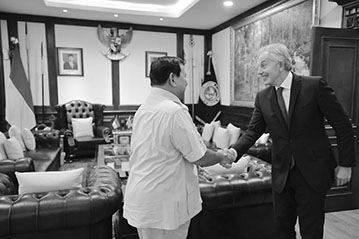 revealed by a local news magazine following interviews with members of Kopassus, Prabowo (as newly-appointed head of Kostrad, Indonesia’s army strategic reserve command) had orchestrated undercover military operations involving troops, gangsters and goons to provoke the looting and destruction of ethnic Chinese businesses in Jakarta and other cities in Indonesia, and the mass rape of ethnic Chinese women. This was an attempt to scapegoat local Chinese communities and justify a military crackdown on genuine anti-imperialist protests and riots.
Whilst the above mentioned planned participation of Indonesia in the expanded gathering of Asian leaders in Shanghai was significant as another a sign of the breakdown of the Western world imperialist order (and to that extent only should it be welcomed), it is completely misleading to imply that there is therefore something ‘progressive’ about Prabowo and his nationalist “cuddly grandfather” rebranding. Rather, the planned visit was a part of desperate moves by the stooge Indonesian ruling class in response to Trump isolationism and the growing revolutionary turmoil being stirred up by capitalism’s crisis. Given his clearly stated hostility to communism and the influence even of Chinese revisionism as quoted above, Prabowo must have hated to the core the very idea of flying to Beijing.
His imperialist stooge instincts are further confirmed by his 23rd Sept ‘tough guy’ speech at the United Nations General Assembly in which called for “the safety and security of Israel” to be guaranteed and raised the possibility for the first time of majority Muslim Indonesia recognising the Zionist settler colony as a “state” as part of a bogus “two-state solution”, and thereby set a precedent for others to follow. He also pledged to deploy 20,000+ troops to stooge UN ‘peacekeeping’ in Gaza or elsewhere if needed. He was praised to the hilt by Trump at a multilateral meeting on the Middle East involving Muslim-majority and Arab states:
“Great speech, you did a great job, pounding at that table,” Trump told Prabowo. “I said, ‘How would you like to deal with him when you left? It’s not easy.’ You did a great job. Thank you very much.”
This followed an announcement last April of a proposal to shelter injured Palestinians, and more a recent plan to open a medical facility to treat wounded Gazans. As the bourgeois press reported, these were rightly opposed by Islamic groups suspicious that they would help facilitate Zionism’s ethnic cleansing of Gaza:
Indonesia will convert a medical facility on an uninhabited island to treat about 2,000 wounded residents of Gaza, according to a spokesperson for the president.[…]
The announcement follows a report by Axios in July that the director of Israel’s Mossad spy agency had visited Washington to seek US help in convincing several countries, including Indonesia, Libya and Ethiopia, to take in hundreds of thousands of Palestinians from Gaza.
The three countries mentioned reportedly expressed an “openness to receiving large numbers of Palestinians from Gaza”.
A spokesperson for the Indonesian foreign ministry unequivocally denied the report to the Guardian at the time, saying the government “had never discussed such a plan with anybody”.
This week’s announcement also comes months after an offer from Indonesia’s president Prabowo Subianto to shelter wounded Palestinians drew criticism from Indonesia’s top clerics for seeming too close to US president Donald Trump’s suggestion of permanently moving Palestinians out of Gaza.
Buya Anwar Abbas, the deputy chair of Indonesia’s Ulema Council, warned Indonesians in April to be wary of Prabowo’s offer.
“Learning from history, Indonesia must be smart in dealing with Israel’s manoeuvres. We must not allow our country to be deceived,” he said.
If medical aid is needed for Gaza residents affected by Israel’s recent attacks, he argued that treatment should take place in Gaza, not elsewhere.
“As a nation that endured 350 years of colonisation, we must recognise that occupiers have countless tricks and deceptions. We must not fall for their sweet words,” he said.
Another senior leader from Indonesia’s largest Muslim organisations, Nahdlatul Ulama, Rais Syuriah, also questioned the motive of the plan.
“Is there a guarantee they can return to Gaza? Aren’t there many Palestinians out there who still can’t return home?” he asked, “This could actually make it easier for Israel to occupy more Palestinian land.”
If any more proof is needed of Prabowo’s pro-imperialist, pro-Zionist stoogery, just look at the role the sinister role warmonger Tony Blair’s institute plays in Indonesia’s affairs as reported by Middle East Monitor.
In April 2024 (just a month after his presidential election victory), Prabowo held a closed-door meeting with Blair. They discussed “defence and other global issues” (Would that include remilitarising Indonesia and opening diplomatic relations with “Israel” by any chance?). Relations have deepened:
Indonesia has long positioned itself as a steadfast supporter of Palestine. Government officials deliver speeches condemning Israeli aggression, and mass demonstrations regularly call for justice and liberation. The country’s constitution explicitly opposes colonialism and upholds human dignity. Yet these commitments may well be undermined by Indonesia’s ongoing collaboration with the Tony Blair Institute for Global Change (TBI)—an organisation recently linked to postwar planning for Gaza that aligns disturbingly with forced displacement.
If Indonesia seeks to uphold a principled stance on Palestine, then its ties with TBI must end.
Recently, The Financial Times exposed the Institute’s involvement in “Project Aurora”—a postwar economic development scheme for Gaza devised by Israeli businessmen and the Boston Consulting Group. The plan proposed the so-called “voluntary relocation” of up to 500,000 Palestinians, each offered $9,000 in exchange for leaving their homeland. Behind the technocratic language was a chilling agenda: to engineer a depopulated, investor-friendly “Gaza Riviera,” complete with luxury developments, artificial islands, and blockchain-regulated trade zones.
TBI was not a passive observer. Its personnel participated in meetings, strategy groups, and messaging discussions related to the project. Tony Blair himself was briefed on the plan. The Institute’s networks helped link the project to the Gaza Humanitarian Foundation (GHF), which has been widely criticised for militarizing aid under U.S. and Israeli oversight. GHF-linked convoys have been implicated in the deaths of more than 700 Palestinians—[now 1000–ed] many killed while desperately trying to access food.
This is not an abstract moral concern. TBI’s direct involvement in such a plan demands accountability. And yet, the Institute continues to be welcomed at the highest levels of Indonesian policy-making—and now operates with a permanent office in Jakarta, further entrenching its presence in national decision-making circles.
TBI currently advises Indonesia’s Ministry of Communication and Digital Affairs, the Ministry of Health, and the Ministry of State Apparatus Utilisation and Bureaucratic Reform. It plays a central role in INA Digital, the national GovTech program. It contributes to strategy across AI, cybersecurity, digital identity, and public service integration. It has helped shape policies on biometric surveillance, pandemic readiness, and data governance.
But TBI’s influence does not end there. Tony Blair himself sits on the steering committee for Indonesia’s new capital city project (IKN)—a generational undertaking set to shape the country’s urban, ecological, and economic trajectory. He has also been appointed as a supervisory board member of Danantara, Indonesia’s newly launched sovereign wealth fund, which aims to drive national development through large-scale investment and global partnerships.
These roles grant Blair and his Institute extraordinary access to Indonesia’s long-term strategic priorities. That access now comes with severe ethical and political implications.
This is now compounded by Trump’s sickening proposal to have Blair, the Butcher of Baghdad, installed as a new colonial governor of an ethnically-cleansed Gaza.
So why would Western imperialism want to topple this???
Meanwhile labelling the Nepali upheavals as a “US colour revolution against China” is also simplistic, although this time, there was a counter-revolutionary outcome.
US-imperialist intervention may have played a part in the violent unrest that brought down the bourgeois, anti-monarchist government alliance of former ‘communists’ in the NCP-UML and the ‘left’-reformist Nepal Congress. However, India’s close proximity to Nepal, its decades-long history of meddling in Nepal’s affairs, and Nepal’s growing tilt away from India and towards China since the 2006 conclusion of the decade long People’s War anti-monarchist revolution make it more likely that much of the external influence came from India.
Indian-born Marxist writer Vijay Prashad has explained how Nepal’s petty bourgeoisie, oppressed and frustrated by the harsh Hindu caste system that still persists despite the revolution, have been inspired by a powerful fascist Hindutva bloc consisting of Narenda Modi’s BJP fanatics in India and various Indian and Nepali monarchist groups to welcome a return to the monarchy in Nepal in the name of Hindu unity.
The Indian state of Uttar Pradesh on Nepal’s southern border, is governed by ultra-reactionary Hindu monarchists, who have been supporting the monarchists in Nepal. These forces are more likely to have infiltrated the protests than the US, who had friendly relations with the ousted Nepali prime minister KP Oli.
Nepal’s upheavals may therefore have been driven more by US-Indian imperialist rivalries than by US hostility towards China.
Suspicious fingers rightly point to the organising role Hami Nepal (a local NGO) played in the protests. They cite as evidence of its pro-Western stoogery the presence of the logo of the New-York-based anti-communist Students for a Free Tibet on its website, and documents indicating that it received funds from the CIA’s National Endowment for Democracy.
Even more significant given Nepal’s historically recent revolutionary overthrow of monarchical feudalism is that the logo of the vicious Nepalese-monarchist colonial mercenaries in the Ghurka Welfare Trust (backed by the British Ministry of Defence and royalty, and based in Salisbury) is still displayed on their website.
However, restricting the analysis of the Nepali unrest to the foreign donations and support received by NGOs like Hami Nepal takes the upheaval out of all historical and economic context and thereby over-simplifies the matter.
Any meaningful analysis has to begin with the heroic revolutionary People’s War victory against the tyrannical absolutist Hindu monarchy, fought for over a decade in the harshest conditions imaginable. It amounted a revolutionary leap in Nepal’s historical development from a long out-of-time feudal order to a bourgeois-democratic republic.
World imperialism and emerging Indian regional imperialism has been seething ever since, and looking for an opportunity to reverse all the all revolutionary gains of Nepal’s workers and peasants.
The wholesale destruction of Nepal’s entire state ministries and burning of tens of thousands legal documents, public body reports, birth certificates, company registrations, etc., and the torching of over a third of local government buildings in the unrest is part of this counter-revolutionary reversal.
Tellingly, whilst homes and offices associated with various political parties were attacked, including that of Prachanda, the Maoist leader, the monarchist Rashtriya Prajatantra Party was spared, as Prashad points out.
Royalists had already gone on the rampage last March in violent “bring back our monarch” protests, burning government offices and the homes of politicians, so the pattern is similar.
The support given to the new coup government by the tongue-sucking weirdo-mystic Dalai Lama, and his recollection of the past support Nepal’s deposed royal Shah Dynasty gave to his pre-feudal Tibetan anti-communism is the clearest sign yet of the counter-revolutionary nature of these developments:
Dalai Lama has extended congratulations to Sushila Karki on her appointment as Nepal’s interim Prime Minister.
In a message shared by his office, the Tibetan spiritual leader recalled the long-standing ties between the Nepalese and Tibetan peoples and expressed gratitude for Nepal’s support in rehabilitating Tibetan refugees since 1959.
Despite this, the fact that Karki, a bourgeois supreme court judge, was selected by the military to lead the ‘interim’ administration over an out-and-out monarchist indicates the huge challenges the feudalists and their Indian backers still face in their despicable attempts to reverse the gains of revolution.
It does not automatically follow from all this that the self-styled Gen-Z youth movement, pushed to the streets by mass unemployment and rising inflation, set out with the intention to topple the government, let alone restore the monarchy.
The scale of destruction went far beyond anything the naïve youth – protesting on 8th September against corruption and government restrictions on (largely) Western social media companies (whose apps many depend on for their livelihoods and to remain connected to families and friends working overseas) – could hope to achieve if it was their intention, and the signs are that it was not. However, “nepo-kids” posts and videos of mysterious origins, allegedly of the children of politicians flaunting their luxury lifestyles, did help to stir up resentment and whipped the protests up into frenzy.
The unnerving presence of sinister, well-organised monarchist elements attempting to infiltrate their protests is clear from these bourgeois cuttings:
On the morning of September 8, Nepal’s capital became the stage for one of the country’s largest youth-led protests in decades. Thousands of students and twenty-somethings, many still in school uniforms, flooded Maitighar Mandala. They carried flags, placards, and slogans: “Shut down corruption – not social media.” “Unban social media.” “No More Nepo Babies.” An Instagram page called Gen.Z Nepal had circulated instructions in advance, stressing non-partisanship. Protesters were told: no party flags, no political leaders, no monarchist infiltration. Organisers even disavowed pro-royalist figures like Durga Prasai and members of the former royal family who tried to attach themselves to the movement.
*************
As the largely leaderless youth movement marched towards the Everest Hotel, men arrived on motorcycles and in trucks, waving Nepali flags with its twin triangles. They raised extremist slogans and pushed past barricades to restricted zones... The burning and looting started soon after…shocking a movement that had expressly warned its tens of thousands of followers on social media not to act violently, even as at least 19 protesters were killed on Monday after security forces opened fire.[…]
By Tuesday, some of the young protesters…stayed off the streets. But the capital had descended into chaos. The Parliament burned, as did the Supreme Court. Hotels were set on fire in a city that depends on adventure and spiritual tourism... Homes and offices of government officials were attacked.
“Killing people, demolishing things, vandalising, looting, this is not our generation,” Ms. Pandey said.“We wanted progress, not to push things back by 10 years at least because everything has been dismantled.”
The last point is significant as sign that there was sympathy among the youth protesters towards the Maoist revolution that had overthrown the caste-ridden feudal-Hindu monarchy in 2006, and that they wanted to maintain the gains won by that 10-year long struggle, but had genuine grievances that were not being addressed.
This is echoed by Prachanda, the leader of the Maoist revolution, who declared his support for the youth whilst warning of royalist sabotage (but not spelt out clearly enough):
CPN (Maoist Centre) Chairman and former Prime Minister Pushpa Kamal Dahal ‘Prachanda’ has released a detailed press statement outlining his party’s official position on the ongoing Gen Z-led movement, extending solidarity while calling for restraint and an independent judicial investigation into the violence.
In his 10-point statement, Prachanda paid tribute to the young protesters who lost their lives and expressed condolences to bereaved families. He said the government’s “barbaric crackdown and massacre” against youth demanding good governance and accountability was to blame for the current turmoil.
Prachanda also distanced Gen Z protesters from widespread acts of arson and vandalism that followed, including attacks on Singha Durbar, the Supreme Court, and political offices, arguing such incidents were the work of “unwanted elements” who infiltrated the movement.
He criticized the Congress–UML alliance as an “unnatural coalition” that failed to deliver governance reforms and instead imposed social media restrictions and corruption-fueled misrule. According to him, this created conditions for a youth-led uprising.
The Maoist leader emphasized that Gen Z’s agenda aligns with his party’s long-standing demands for directly elected executive leadership, property investigations of top officials, and stronger measures for inclusion and social justice. He reiterated that the movement should remain within the constitutional and democratic framework, warning that unconstitutional exits could benefit regressive forces.
Calling for calm and dialogue, Prachanda urged citizens to avoid destruction of public and private property while expressing readiness for his party to back progressive change, good governance, and inclusive democracy.
He also praised President Ram Chandra Paudel’s ongoing initiatives and the Nepali Army’s role in maintaining peace and security, while appealing for broad national unity in defense of the constitution and republican democracy.
Further analysis is needed on the extent to which Maoist theoretical confusion may have contributed to this dire situation by preoccupying themselves after the revolution with Stalinist-influenced Popular Front alliances with the two ousted parties instead of taking an independent class position alongside (but separate to) bourgeois-democracy, to push it as far as it can go whilst constantly exposing its limitations and preparing the workers and peasants for socialist revolution, – which includes warning the masses of the coming capitalist-crisis Catastrophe and world war.
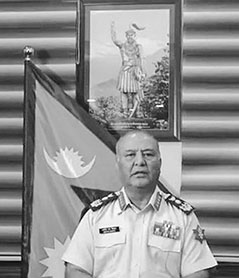 The extent to which Nepal’s royalist army was dismantled following the revolution needs to looked at part of this. The Maoists had begun this process by integrating People’s Liberation Army fighters into the army and attempting to remove the generals from power, but the appearance of current army chief calling for “peace and order” in front of a portrait of an 18th century Gorkha Kingdom monarch in a televised address suggests that this has stalled, as do revelations of talks between the army chief and monarchists (opposed by the youth protesters) If so, Prachanda’s final comments at the end of this piece are dangerously disarming and smack of Allendeism:
KATHMANDU, Sept 11: Questions and criticism have mounted over the role of the Nepali Army in the aftermath of Prime Minister KP Sharma Oli’s resignation, which followed the Gen Z protests.
President Ram Chandra Paudel formally accepted Oli’s resignation on the afternoon of Sept 9. While Oli stepped down in line with the demands of the Gen Z protesters, many have criticized the national army for remaining silent even as demonstrators vandalized Singha Durbar, Parliament, the Supreme Court, and the President’s Office (Sheetal Niwas). The Army only deployed to the streets after 10 PM on the same day.
The national army later invited Gen Z protesters for dialogue. However, during the meeting, Chief of Army Staff Ashok Raj Sigdel mentioned controversial businessman Durga Prasai and the Rastriya Swatantra Party (RSP) as stakeholders in the movement. This prompted some Gen Z representatives including Rakshya Bam to walk out of the talks.
Speaking outside Army Headquarters, Bam said: “The Chief of Army Staff called us to meet the President and asked us to sit for talks with Durga Prasai and the RSP group. Once the Chief himself declared them as stakeholders, we realized the sacrifices and transformative journey of the Gen Z movement would be undermined. So, we rejected the proposal and walked out.”
Her claim was later reinforced when Durga Prasai released a photograph with the Army Chief on Wednesday, stating that they had held in-depth discussions on the country’s latest situation and future course. Prasai, a businessman advocating for the restoration of monarchy, has been widely criticized for his controversial campaigns, including urging people not to repay loans from banks and microfinance institutions.
“This meeting with a disruptive figure like Durga Prasai at a time of national crisis raises serious suspicions about the Army Chief’s role,” a senior Army official told Republica.
The controversy deepened after former president of the Federation of Nepali Journalists, senior journalist Kishor Nepal, posted on social media platform X (Twitter) that during a Sept 9 security meeting held in the presence of President Paudel, the Army Chief had urged the President to resign, assuring him that the Army would handle the situation thereafter.
According to Nepal, the President replied: “I will not resign. Instead, you may kill me and blame my death on the protesters. After that, do whatever you want.”
The fact that youth protesters in Bangladesh, Indonesia, Nepal, the Philippines, Madagascar, Georgia and elsewhere all declare themselves to be part of the same movement, find inspiration in each other, give themselves a Gen-Z branding and even in many cases carry the same comic-book Jolly Roger flag does not prove that they are either all genuine revolutionary movements to be supported (as the Trots say), or US colour revolutions to be opposed (the Stalinists).
All this does is demonstrate confusion amongst the youth and the need for Leninist theoretical grasp and leadership. This cannot be found in the r-r-r-revolutionary posturing of the anti-communist Trots or in the sour defeatism of the Stalinists, who just add to the confusion by taking the wrong side when their simplistic ‘perfect revolution’ pipe-dreams hit up against the reality of a capitalist system heading towards complete chaos and collapse, and polarising and fragmentating societies and driving revolutionary turmoil everywhere.
Only Leninist revolutionary theory and party-building can cut through all this confusion to bring the clarity and leadership the youth and workers everywhere need to bring down this stinking capitalist system forever and establish societies of socialist co-operation.
Build Leninism.
Phil Waincliffe
Back to the top