


Recent issue
No 1231 May 4th 2004
Only continued deliberate fabrication of "anti-terror" hysteria prevents even greater humiliation for the Western imperialist warmongering farce than has been incurred already by-the occupation catastrophe in Iraq and the NAZI interrogation/torturing of prisoners by the US forces. But the increasing setbacks on the military, political, and economic fronts make discussion of the far-reaching defeat implications for imperialism unavoidable, amounting to vastly more than just the disaster of having to pull out of a hopeless immediate situation. The American Empire is deep in contradictions it cannot get out of, even via a World War III expansion of the current blitzkrieg chaos and re-colonisation tyranny against the entire Third World. Anti-imperialism is looking unbeatable.
The continued rapid falling-apart of the imperialist warmongering recolonisation in Iraq puts more point than ever on the need for a complete Marxist analysis of all the implications in this unprecedented crisis.
The latest humiliating setbacks in the retreat from Fallujah and the revelation of torture-atrocity scandals accusing the US occupation-blitzkrieg of brutalising Iraqi prisoners, as well as carnage against defenceless women and children in Fallujah, suggest that demoralisation and defeat are now in view for the American Empire.
Automatically, bets are getting placed about how long the USA can put up with this shams and confusion, and whether it might just "pull out" in order to "avoid more losses and embarrassment."
But can America just "pull out" now????
Such thinking surely loses concentration on all the really big historical-crisis issues involved in this astonishing new phase of Western imperialist warmongering.
The American Empire does not have to think "like Marxists" in order to understand that the major revolt against Western monopoly capitalist domination throughout the Third World that the US global leadership is facing (labelled "the terrorist threat") has to be crushed.
The Empire only has to think like all previous mighty empires in history.
And Washington does not need to be "Marxist" to understand the class-struggle and nationalist struggle contradictions lurking at the base of all historical political developments (check the EPSR box quotes, for example).
It equally follows that Washington's attempted world-economic-control to minimise or destroy revolt opportunities is alert to the vastly increased political dangers from all the chaotic economic fluctuation, mini-collapses, uncertainties, and potentially catastrophic slump collapses of the last 15 years global upheaval.
Thus the EPSR's conclusion so far has been that the USA's massively adventurous Middle East blitzkrieg recolonisation (of Iraq, Palestine, and Afghanistan to start with, but with everyone else under direct explicit threat, and every other "rogue state" or "axis of evil" connection on the planet being menaced too) is both a continuation of America's routine bullying imperialist role anyway as the world counter-revolutionary gendarme (more than 400 coups, invasions, and subversions staged since 1941 to try to halt or overturn the progress of the anti-imperialist struggle), PLUS the added venom and dimensions that Washington had been pouring into its blitzkrieging for at least a decade following the surprising emergence of "international terrorism" after Soviet self-liquidation was supposed to have made the world "safe from communism for ever".
World War III began with the monstrous blitzkrieg destruction of Serbia in 1999, inflicting far more terror-destruction on this part of the heart of Europe than even the World War II blitzkrieg had ever managed to do, ignoring a UN "illegal" criticism to do so, and "justifying" the invasion with the ludicrous "Recak village massacre" fabrication which would have made Goebbels Propaganda Ministry blush, even, — and which put the CIA's Big Brother news tampering management back in full stride such as it was for the outrageous "Gulf of Tonking incident" fabrication, which "justified" the 10-year devastation war on Vietnam and Indo-China.
Like World War I and World War II, World War III began at a point where the "overproduction" contradictions of competing imperialist rivalry for world leadership and economic domination had become no longer containable by the usual backstabbing routines of bullying, arm-twisting trade-war corruption; sordid armaments-supply coalitions; international debt and currency-market manipulations; and the usual gendarme-savagery and sabotage-subversions via influence peddling.
Worldwide, everyone's resistance to the dirty tricks of everyone else was growing by leaps and bounds.
The Third World was becoming rapidly more outspoken and aggressive against Western imperialist domination.
Marxism would suggest that the anarchy of private monopoly capitalist empires was approaching a periodic "overproduction of capital" crisis (see EPSR box).
Further, it would suggest that in these globalised industrialisation-exploitation conditions of a rapidly maturing international proletariat, the 800-year world domination by Western monopoly-imperialist finance was approaching terminal REVOLUTIONARY crisis.
Washington meanwhile was arrogantly openly describing the situation, especially
in the aftermath of the Sept 11 2001 humiliation to its "world mastery",
as "there is
now a threat to all our freedoms, and to our very way of life.
"We are going to war on terrorism,and henceforth, we will consider everyone who is not with us to be against us.
"And we will not tolerate ANYONE even attempting to rival the USA in arms-might or in armaments technology".
There is no Marxism in this. Every empire in history has sought to survive in similar fashion as the effective world ruler.
Maintain vastly superior force, and when every trick of arm-twisting bribery, corruption, and treachery has failed to keep order, — then come down utterly ruthlessly with ALL that force on EVERY "rogue element" that can be identified or slandered.
This is the epoch of deliberate World War for inter-imperialist rivalry and counter-revolutionary tyranny to try to re-establish a stable and domineering pecking order once again via wiping out as much as possible of "everything that has been causing the trouble", etc, etc.
So how does the American Empire "pull out" of this colossal warmongering tyranny that Washington has decided can no longer be avoided, — effectively against the WHOLE of the rest of the world if everyone decides to get in Washington's way.
Superficially, of course, and for tactical military reasons, any particular engagement can be terminated for any number of reasons, as is already happening in fact around Fallujah.
And that could easily apply to Iraq as a whole, or any other target area, in the context of much larger-scale warmongering or warmongering preparations that might get under way in the American Empires perspective to remain the world's ruling power, come what may, taking on EVERY challenge to its domination.
But Iraq at the moment remains at the heart of Washington's own definition of what it is determined to impose upon the whole world, — a "democratisation" process (by "negotiation" and by "peace process" or by WAR) to allow only America-friendly "freedom-loving" regimes to flourish on Earth unthreatened or unmolested, — this "freedom-loving" and "democratisation" in effect equating ONLY with state-conduct and state-ambitions that the USA itself approves of.
For the moment, the aim in Iraq remains to establish a stable stooge regime loosely cooperating with, or at least not actively resisting, the overall American imperialist aims in the Middle East and in the whole world at large.
For temporary tactical reasons, Fallujah can indeed be pulled out of.
And in no way does that remotely lessen the importance of the American DEFEAT there, — the crucial future development to be studied (see below).
The huge US setbacks in general dominate the entire story (see below).
But all that this does, surely, is to underline the colossal, far-reaching, historical implications of all that is going on in this unprecedented Middle East blitzkrieg by the "democratic" rulers of this "modern" world.
The response to this utter stupidity of American imperialism inflicting recolonisation warmongering on the proud Arabic and Muslim traditions of the INDEPENDENT Middle East, — and FAILING in the attempt, — is surely not to suggest a "pull-out" humiliation and leave it at that, but precisely to raise the ENORMOUS consequences, — — impossible to over-exaggerate, — and ENORMOUS implications for the whole world's future, if this astonishing US blitzkrieg adventure DOES fail.
By all means let the EPSR's "catastrophism" or "crisisism" be proved wrong. In the long run, that wouldn't matter a bean to anything lasting or important.
But to let possible sparks for a Marxist perspective on this huge crisis NOT be heard, wherever they come from, would be the greatest irresponsibility.
IF the world is as Marxist-Leninist science has hitherto tried to interpret it, — then it is crucial for as many potential sources of new Marxist understanding to be heard as possible, and as loudly as possible, so that all the spontaneous leaps in revolutionary anti-imperialist struggle should come into contact with the worldwide gathering of global revolutionary consciousness which must slowly be happening too.
Hiding an embarrassed revolutionary light under a "they'll pull out" sceptical bushel hardly makes sense unless there are really sound arguments for the doubts.
At the moment, however, it is only RETREAT that is on imperialism's plate, and not any deepening of the world's warmongering revolutionary crisis at all.
Total disillusionment has fatally undermined all of the Washington warmongers "shock and awe" and "hearts and minds" wishful thinking about how the world would react to the blitzkrieg on the Saddam regime.
The chaotic American indecision and humiliation around Fallujah, and the spate of revelations about the brutalisation of anti-imperialists who have been taken prisoner, reflect rapidly increasing confusion and demoralisation about the whole ostensible purpose of the USA's invasion and occupation and "rebuilding" of Iraq.
And this in turn is dictated by the ultimately crucial development of UNBEATABLE resistance to global imperialist bullying, beginning to be visible internationally throughout the entire Third World, but especially throughout the Middle East in Palestine, Afghanistan, and Iraq.
And if this IS what lies behind all the difficulties that this imperialist warmongering onslaught is running into, then it is a historical transformation to end all historical transformations.
It starts to mean what Marxist science has always explained was eventually inevitable (see EPSR box),the growing-up of the world's proletarian masses to the point where they can no longer tolerate the inequality and exploitation under the Western imperialist system, and where the "overproduction" accumulations of the monopoly-capitalist market anarchy mean that economic and political catastrophes start to predominate over economic and political benefits, making it impossible for imperialism to rule on in the old way either.
Total revolutionary upheaval is the only possible outcome.
These are the really interesting implications, beyond the humiliation of a mere enforced "pull out", of US imperialism's warmongering difficulties in Iraq.
And there are even occasional hints of all this within the frank imperialist press admissions that all is far from well with this re-imposition of Western "discipline and stability" on the world to "save our way of life", etc, etc.
Everyone knows the "freedom" bullshit.
And so most of those involved in this rotten bullying adventure show obvious political uneasiness now that things have started to go so spectacularly wrong.
If the whole military recolonisation adventure had gone through smoothly, hardly a qualm would have been heard from any direction for long. But with the occupation going badly, the gripes and doubts start to multiply everywhere, — all the more so because of the huge stakes at issue for the whole of world history.
The Fallujah debacle deserves recording in the bourgeois media's own admissions:
US military commanders in Iraq yesterday revealed a deal negotiated to end the siege of Falluja that would leave the security of the town in the hands of 1,100 Iraqi soldiers, led by a former general from Saddam Hussein's army.
If the agreement sticks, it would represent a remarkable volte-face by the American forces who surrounded the town three weeks ago after the murder and mutilation of four US security contract workers.
Though the details of the deal were sketchy last night, the withdrawal of US troops did not appear to depend on the killers being given up, or on the insurgents surrendering their heavy weapons — key demands that had prompted the siege.
Only a day earlier, a senior American general in Baghdad had suggested it would be "unnecessary and ludicrous" for US marines to withdraw.
But last night there were reports that marines in the city's southern industrial area were already packing up, loading trucks and pulling out, although American warplanes pounded the besieged city for the fourth night running.
Jets attacked at least three separate areas of the city, including the Golan district, where insurgents have defied the US military since the beginning of the month.
Hours earlier, US commanders had announced the deal, after three weeks of halting negotiations.
The newly created Iraqi force would be known as the Falluja Protective Army.
Under the agreement; marines would withdraw from positions in and around Falluja, while the FPA formed a cordon around it and moved into the city. But after another day of carnage in Iraq which saw 10 US soldiers killed there were no guarantees that the agreement would work.
"So far the Americans haven't been able to enter the centre of Falluja and this in itself is a victory," said Mohammad Tariq, a representative of the city council who has been involved in the negotiations and was last night in Jordan talking to UN and Red Cross officials.
He said that under the agreement the soldiers who are supposed to join the new security force which will operate inside the city will be former Iraqi army members from Falluja.
He said Gen Salah had not been among the insurgents fighting the Americans in the city. Yet there remains the possibility that some of the gunmen who have fought may be quietly absorbed into the new security force.
Perhaps the most important moment in the negotiations came at the weekend, when the marines appeared poised to mount a major offensive in the city. Paul Bremer, head of the civil administration in Iraq, travelled to Falluja to join the negotiations and, after consultations with Washington, the attack was called off.
A car bomb near Mahmudiya, south of Baghdad, killed eight US soldiers and wounded four. Two others were shot elsewhere.
In Basra, gunmen shot dead a South African civilian near the offices of an oil company.
THE soldiers of the 1st Battalion, 5th Marines — the "Devil Dogs" — were stunned. After 25 days of intense urban warfare, hundreds of casualties and repeated declarations of America's determination to crush the enemy, they and the three other US Marine battalions in Fallujah were abruptly ordered yesterday to pull out
"It's kinda bad when you've had friends who've sacrificed everything, then you've had to hand it over to someone else,"
Corporal Travis Box, staring at the ground in his forward base, said. "We weren't doing it for tangible things. We were doing it for intangible things like pride and honour."
"Pulling back is a sacrifice in itself," Corporal Kenneth Thorpe, his head low, added. "You do all the preparation. You work up. You've worked your whole life for this. You're ready for the fight, then you get shut down, suddenly, out of the blue."
Marine battalions are to withdraw in a series of co-ordinated steps to points well beyond the city, and will be replaced by a scratch Iraqi force named the Fallujah Protective Army (FPA).
Worse, the FPA will be commanded by a Sunni general from Saddam Hussein's era, and consist of up to 1,100 men largely recruited from the Fallujah area.
The Marines' reaction was not hard to understand. They had suffered ten dead and seventy-two wounded in the bloodiest battle since the war. The coalition's original goal to root out those responsible for killing and mutilating four US contractors on March 31remained far from fulfilment. And only on Wednesday President Bush had vowed once more to "secure" Fallujah.
It was a curious way to mark the first anniversary tomorrow of Mr Bush's famous "mission accomplished" speech declaring combat operations over, but the coalition had little option. The battle of Fallujah, in which more than 600 Iraqis are thought to have been killed by American guns, mortars and helicopter gunships, had turned into a public relations disaster.
Despite the deal US warplanes continued to strike Fallujah last night, and the action was not over for the Marines.
Driving through rubble-strewn streets a sudden burst of heavy firing broke out "Firefight, firefight," yelled the men, who jumped from their Humvees to take up positions.
A plume of smoke erupted from a checkpoint. A car with three armed Iraqis inside had tried to run the position, firing as they did so. All died as US military police riddled the vehicle with a machine-gun.
"Way to go! Get some carnage, get some! Way to go, readyman," one Marine shouted.
That brutalisation indicator is another measure of how disastrously this "we
are bringing you freedom and democracy" exercise has failed.
The ruthless NAZI-military tyranny is there is full measure, but the downtrodden of Iraq are absorbing the worst that recolonisation can inflict, yet coming out of the ordeal feeling triumphant, — as the following capitalist press reports admit:
"The Americans have violated the ceasefire. They are attacking us with jet fighters, tanks and artillery. The US snipers are on every roof and minaret. They don't care who they shoot. They are shooting old people, women and children. Where is the UN in all this?"
After days of bombings and sniper fire, it was not surprising that Mr Ahmed and other refugees were sceptical that a new ceasefire deal (under which an 1,100-strong Iraqi force commanded by one of Saddam Hussein's former generals will take over security) would hold. "By the time I get back to Falluja everything will be destroyed," Mr Ahmed said.
In the meantime conditions for the civilian population still stuck in Falluja were hellish.
Abu Mohammad, 30, who left the town yesterday morning, said: "There is no electricity. There is no water. There are no food supplies at all." He said the US war planes and helicopters that have been pounding Falluja for the past three days had been targeting civilian areas.
"They are bombing civilians. When I was about to leave there were two ladies trying to get out. American snipers shot them dead. Their bodies are still lying out on the street in alJumhuriya. The roads are deserted. All the area is bombarded. We are hearing shelling, artillery, and always the sirens of ambulances."
The US began its siege of Falluja more than three weeks ago after the killing and mutilation of four US security contractors. The Bush administration has tried to portray the insurgents inside the city as either foreign fighters or diehard supporters of Saddam Hussein. On Wednesday, Tony Blair described them as "former regime elements" and "outside terrorists".
Yesterday, however, those from Falluja could not understand Mr Blair's claim. The insurgents were not terrorists but Iraqis, they did not support the old regime. and were merely fighting a patriotic war against American occupation. "The people doing the fighting are locals," Mr Mohammad, who fled with his wife and six children,said. "They are not people who support Saddam."
Others complained that the Americans had created the problem in the Sunni town west of Baghdad by using indiscriminate and excessive force which was more appropriate to a battlefield than a residential area. "There is no mercy at all," said Sami Sabri, 65, who arrived at the camp a week ago said. Two of his cousins, Kalif Ali, 22, and Issam Shaker, 19, had been shot dead by US snipers.
"All they did was open the door of their house. They were trying to leave. The Americans killed them. We picked up Kalif's body and buried him in the football stadium. We did not have a proper ceremony. We just dropped him in the tomb and left for Baghdad."
What did he think of the Americans now? "I want to kill them all," he said.
Muthana Harith al-Dhari, spokesman for the Muslim clerics' association which has been attempting to mediate in the Falluja standoff, said the coalition's analysis of the situation in the town was fundamentally wrong.
Dr al-Dhari admitted some Saddam supporters could be inside the town but put their numbers at "no more than 100". Alone, they would not be able to defy the US military, he pointed out. "This is a widespread and popular revolt based on Islamic principles," he said, adding that a similar insurgency was going on in the southern city of Najaf — a Shia area with no Saddam supporters at all.
Yesterday Mr Ahmed, who left Falluja with 13 members of his family, some of them sitting in the boot of his car, admitted that he held a longtime grudge against the British. The British had killed his brother in 1941, he said, during the second world war.
British troops had just invaded the country for the second time to get rid of its pro-German government. "My brother and I were walking across the desert near Falluja when we were attacked by a British plane. We were just kids. The plane came and shot him from the sky. That was a terrible occupation too."
Crowds of fighters and civilians drove in cars waving the old Iraqi flag in victory and firing celebratory shots in the air as mosques blared songs of victory through loudspeakers. People said they were in favour of Saleh's appointment because he was selected by the local sheikhs and not imposed by the Americans.
Is this a turning point in the wider conflict for Iraq? My tour of Falluja provided startling insights into the degree of resistance there and showed that the siege was not only causing civilian suffering but also proving counter-productive for the Americans.
When I had arrived in Falluja on Tuesday I found that what had once been a bustling city of 300,000 lay still and silent but for the hum of drones and warplanes. Neighbourhood after neighbourhood seemed empty. The busy markets, street vendors, beggars, black-clad women and playing children had disappeared.
Those who remained were fighters. They called themselves mujaheddin and came from all walks of life: a first-year medical student, a car mechanic, a pharmacist, a trader, a teacher and many sheikhs. They spoke of fighting to the end and exchanged stories of successes against the marines. Religion and fantasy interacted together.
Giant scorpions, 50cm long, were said to be attacking the Americans. Internet photographs of these monsters were handed around. "God has sent us his warrior angels in the form of these scorpions," I was told.
An account of the appearance of the Prophet Muhammad was repeated. To chants of "God is wondrous" the story was told of how the prophet scolded a man for leaving Falluja when he himself was fighting alongside the mujaheddin.
Names of "collaborators and spies" were exchanged. There was talk of "mercenary Kurds" accused of being Mossad agents fighting alongside the marines. A handful had confessed under interrogation, I was told, and had been summarily killed. Some had been shot; others had had their throats cut.
A tall, skinny sheikh with piercing eyes agreed to escort us to the Golan district. He identified himself as a senior commander of the resistance.
Slowly we drove in silence through the empty streets.
Armed men emerged to greet the sheikh and his guests and we were led into a house where a dozen fighters were sharing lunch. They squatted in a circle around two large aluminium trays of rice and meat and dug in with their hands, the traditional Iraqi style of eating. Tea was served and the men were ready to go back to their positions.
For the next few hours I was given a tour of the shattered neighbourhood. I was told to walk against the walls and fences to avoid sniper fire. The stench of death drifted from some of the alleyways.
Garbage littered streets that were scattered with leaflets dropped by American warplanes warning the resistance to give up or face death.
Rabii Saleh Dahi, 31, wobbled up on a battered bicycle. He said he had lost at least 27 members of his family in one attack. His uncles, aunts and cousins had moved into his grandparents' house for safety, only to be hit by two bombs from an F16. His younger brother had disappeared: "We do not know where he is or where he has gone, only that he seemed to have lost his mind."
According to the resistance, 586 people died in the first week of fighting and the toll had since risen to about 1,100. The figures were collated from doctors and local leaders and may be an overestimate because of double counting and unsubstantiated reports.
We stopped at a makeshift first aid clinic in a mosque. In charge was Maki al-Nazzal, an English-speaking former employee of Intersos, an Italian agency. He spoke with bitterness of the women and children who had filled his ward and complained angrily about US tactics: "By killing women and children they are hardening the people of Falluja and turning them more against them [the Americans]."
He said that despite the apparent emptiness of the city many families were trapped in their homes. After long negotiations with the Americans, he had won permission to send a doctor out to help with medicine and food.
Sheikh Thafer al-Ubaidi, the godfather of Falluja's resistance, also spoke to me. The sheikh, known for his fierce sermons, argued that American "blunders" had turned Falluja into a centre of resistance. It was a town of large tribes who rejected the presence of uninvited foreigners. Searches for Saddam loyalists offended the conservative traditions of the area, he said. Soldiers stormed houses at night, searched unveiled women and humiliated men in front of their wives and children.
Thafer said all the tribal leaders and religious figures condemned the mutilation of the four Americans whose deaths triggered the fighting. Like other figures in the city, however, he did not condemn the actual killings. Many people I spoke to claimed the men had been mercenaries.
Thafer insisted that he had detested Saddam Hussein as as a "hateful criminal". But he quoted from an old poem: "I cursed a life destroyed under a lifetime and when I mingled with my new friends I found myself crying for my cursed and lost lifetime." In other words, he found the present even worse than the past.
I had my own brush with American air power while interviewing Saad, the boy sniper, with Ali Rifaat, the Sunday Times correspondent in Baghdad. His car came under fire 200 yards away; apparently from a gunship. The navy blue 1993 Buick Roadmaster was hit twice and burst into flames. Neither of us was hurt, but a local commander was hit by shrapnel.
Yesterday, after the Americans withdrew, ambulances visited frontline areas to bring out bodies that could not be buried during the siege.
The father of one-year-old Asmaa Almwan said angrily that snipers on his roof in the al-Askari district had refused to let him out of the house when she fell ill. When she died they had refused to let him bury her. That was 16 days ago. "I had to put her in the garage," he said.
Yesterday the small parcel wrapped in white cloth was taken to the stadium cemetery for a hurried burial, as her father wept with rage.
Not surprisingly, pro-imperialist morale is plumbing new depths everywhere, and making even more ridicule than ever of the West's grotesque "reconstruction" hypocrisy, which only ever intended to reconstruct super-colonial exploitation, but nothing at all if that proved impossible, as these frank capitalist admissions reveal:
A YEAR after President Bush declared an end to major combat operations in Iraq, violence claimed the lives of ten more US troops while polls showed that confidence among Americans and Iraqis had dipped to new lows.
Eight of the soldiers were killed by a car bomb south of Baghdad. One was struck by a rocket-propelled grenade in eastern Baghdad. Another died in a roadside bombing 40 miles north of the capital.
The casualties took the US death toll for April to 125. Some 426 Americans have died since Mr Bush declared "mission accomplished" on the flight deck of an aircraft carrier a year ago, compared with 109 before.
Polls published yesterday showed the number of Americans and Iraqis backing the US mission in Iraq is falling: Forty-seven per cent of Americans said the US was doing the right thing, down from 58 per cent a month ago, in a New York Times/CBS poll: Forty-six per cent said the US should have stayed out of Iraq, up from 37 per cent in March.
In a Gallup poll in Iraq, clear majorities believed the occupation was doing more harm than good, regarded coalition troops as occupiers and wanted them to leave immediately.
Colin Powell, the US Secretary of State, conceded that the high casualty count was taking a toll on the mood at home.
A year ago Mr Bush pulled off what appeared to be a public relations master stroke, flying in a Navy jet to the USS Abraham Lincoln off the California coast as it headed home.
Pictures of the President wearing a flight suit were splashed on front pages across the US. Mr Bush also declared live on TV from the flight deck: "Major combat operations in Iraq have ended. In the battle of Iraq, the United States and our allies have prevailed."
He also referred to "images of celebrating Iraqis", and said that the invasion of Iraq had marked "the turning of the tide" in the war on terror.
Ted Kennedy, the Massachusetts senator, branded Iraq "President Bush's Vietnam", and added: "It may well go down as the worst blunder in the entire history of American foreign policy."
A year ago, Mr Bush's approval rating was 71 per cent. Today it is 46 per cent, the lowest level of his presidency.
The Gallup poll showed that 18 per cent of Baghdad residents said that the occupation was doing more good than harm, down from 32 per cent last summer. Sixty per cent said that it was doing more harm than good, up from 36 per cent. When the poll included Iraqis from all other parts of the country, 57 per cent wanted coalition troops to leave immediately.
Seven out of ten Iraqis saw coalition forces as occupiers, compared with 43 per cent at the time of invasion. Then, 43 per cent regarded them as liberators, a figure that had dropped to 19 per cent.
The poll of more than 3,500 Iraqis was taken door-to-door across the country before the siege of Fallujah and the stand-off in Najaf.
If Kurds, who make up 13 per cent of the Iraqi population, are stripped away, 81 per cent of Sunnis and Shias regarded the US forces as occupiers.
Vital reconstruction work in Iraq has almost completely
ground to a halt after being "screwed up" by the deteriorating
security situation in the country, senior coalition officials have told
the Guardian.
Unless the situation improves dramatically in the next few weeks, essential work on the electricity network will not be complete before the extreme heat of the summer arrives, raising the prospect of months of power cuts similar to those that led to riots and widespread discontent last year, the officials warned.
"It is screwing up the timetables completely; so for things like electricity, essential work that should have been done over the last three or four weeks has not been done," one senior official said.
"We are at risk of moving into the summer period with the repairs not complete, which means we are going to have massive demand and not very good provision. So from that point of view, it is a disaster."
The warnings came as it emerged that the insurgency has forced two of the biggest contractors, General Electric and Siemens, to suspend operations in Iraq. Siemens has been involved in attempts to restore the Daura power plant in Baghdad, listed by USAID, the development agency, as being one of the most important electrical projects in the country.
The security problems are delaying work on about two dozen power plants, as well as a number of large-scale water and sewage treatment projects across Iraq.
The American-run coalition provisional authority has always considered the reconstruction and rehabilitation of Iraq's electrical and water infrastructure as being key to persuading Iraqis of America's goodwill, as well as crucial in efforts to create a functioning democracy.
Officials said that since the increase in violence at the beginning of the month, nearly all foreign contractors working in Iraq had either fled the country or pulled workers back to secure bases.
"The best figure we've got is that about 25% of contractors had currently pulled out of country, albeit temporarily," a coalition source said. "However, that is putting a brave face on it because the other 75%,have pulled back to base. They will argue that they are doing essential activities in the base like getting the paperwork straight. Yeah, well give me a break, how many times can you rewrite the scope of works and re-do your personnel accounts?"
So far this month more than 40 civilian foreign nationals have been kidnapped and 10 killed. In the same period nearly 100 US troops have died, the worst monthly total since the invasion of Iraq.
Several countries including Russia, Portugal, Poland and France have urged their citizens to evacuate amid the wave of attacks on civilians. The government in Moscow offered to airlift more than 800 Russians and citizens of ex-Soviet states out of Iraq after eight Russian and Ukrainian workers were briefly kidnapped in Baghdad.
The men, who spent 19 hours in captivity, were working for the Russian contractor Interenergoservis, building a power plant in Baghdad. It is understood that work has almost entirely stopped since the kidnappings.
A coalition official said one of the main problems was that because of knock-on effects each day's delay now equated to a week's delay further down the line.
"If that continues for another few days or a week then we can keep a brave face on it and say it is not really affecting the critical path with the exception of a few individual projects, but if it goes on very much longer after that then we would have to say we are losing momentum of the project as a whole," he said.
BP's chief executive delivered a serious setback to hopes of rebuilding Iraq when he said that the oil company has no future there.
John Browne, one of Tony Blair's favourite industrialists, indicated he had given up on Iraq because the political and security situation in the country had deteriorated so much.
Yet only 18 months ago he was extremely enthusiastic about prospects, lobbying in Washington and London to ensure American rivals did not cut him out of the action.
"We need a government, we need laws and we need decisions. We have not got any of that yet. A whole range of steps need to be taken," said the BP boss as he unveiled new record profits this week.
Western oil firms originally hoped there would be a bonanza as the country with the second biggest oil reserves in the world expanded its production dramatically.
But these aspirations have evaporated as the hopes of peace following invasion by American and British forces have given way to ferocious guerrilla attacks.
And as the vision of fabulous imperial recolonisation wealth fades, the sordid reality of the entire bogus Western "anti-terror" stance grows ever clearer, — the most naive race prejudice hysteria hyped up by the shoddiest Goebbels-CIA-type propaganda farces imaginable, making complete monkeys of the gullible public back home, — as revealed quietly by the Establishment's own tame "free press" (which nevertheless routinely still falls for every rotten disinformation trick that the Establishment cares to brainwash people with):
TICKETS to a Manchester United game found during anti-terrorist raids sparked fears of a suicide attack on Old Trafford. But they were for an old match and had been kept as souvenirs by the suspects, who were fans of the club.
The revelation will lead to further criticism of the operation which led to the arrest of 10 people by armed Greater Manchester police in dawn raids last month. All have since been released without charge.
Claims that the group — mostly Iraqi Kurds — was plotting to hit a major target such as a shopping centre or a football stadium were widely reported, but turned out to have no substance.
The Observer has learnt that the Attorney General, Lord Goldsmith, was aware that the Sun was planning to run a story claiming that Old Trafford was a target, but decided against issuing an injunction against the paper.
A spokeswoman from the office of the Attorney General confirmed that an injunction was discussed: 'The Attorney General was made aware that there might be an issue over some press reporting.' But the decision was made that action 'would not be appropriate'.
Goldsmith acted to stop the publication of photographs of terrorist suspects arrested across the southeast last month because it was believed it might invalidate identification parades involving the men.
One Whitehall source told The Observer that there was serious concerns within government about the press coverage of the Old Trafford story. It was thought likely at an early stage in the investigation that the suspects were unlikely to be charged.
Eight men, one woman and a 16-year-old boy were arrested in raids across the north-west involving 400 police officers.
The botched operation will also raise questions about the national anti-terrorist strategy of 'disruption'. The controversial policy is designed to unsettle terror cells working within immigrant communities in Britain by carrying out sweeps of arrests which are not necessarily designed to lead to charges. Many Muslim leaders now believe disruption is beginning to alienate communities from the police.
Representatives of Manchester's Kurdish community said they were considering legal action against Greater Manchester Police.
Speaking for the first time about the events, one Iraqi Kurd arrested during the Manchester raids told The Observer that he was not informed of any specific terrorist charges against him and they were simply asked general questions, including what they thought of the war in Iraq.
Speaking through his solicitor, Rebecca Yates, he said: 'I still don't don't know why I was arrested. I don't have any involvement in any terrorist activity and I don't practise any particular religion. I was shocked, ashamed and saddened by the feeling that the good name of the Kurdish people has been shamed by being associated with terrorism.'
Police found photographs of him taken at a United game when they searched his flat. Yates confirmed that the tickets discovered in the raids were old: 'Most young men in the area are Manchester United fans,' she said.
These "terror" hysteria stunts are being organised quite consciously by the authorities to build up a war-scare atmosphere and hatred of all foreigners in which anything goes.
It has been exactly the same sick brainwashing imposition on the public prior to every major imperialist-war outrage in history.
"Stop imperialism" is the only answer to these non-stop "terror" scares, some of which will indeed be obviously real.
Put the sole aim of Western "security" in all this is to panic public opinion into more and more xenophobic warmongering, thus inviting more and more real "terror" threats, and giving more and more opportunities for imperialist authorities to whip up more and more "nuke the bastards" hysteria.
These are monstrous police-state fabrications, equal to the most degenerate Hitler-Goebbels propaganda tricks that German imperialist aggression ever got up to, setting the pace for the Western imperialist warmongering system during its despicable World War II episode.
Nazism is back and never went away. Build Leninism. EPSR
World Revolutionary Socialist Review
(edited extracts from a variety of anti-imperialist struggles).
An independent pubic inquiry might conclude that the British state didn't just collude, but actively commissioned the murder of citizens within its jurisdiction
Pat Finucane 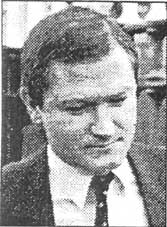 in his short career sought justice for a large number of
people. He was too successful
in his short career sought justice for a large number of
people. He was too successful
The 'inadvertent' arrest of Brian Nelson (FRU agent and British soldier, sectarian torturer and UDA member) and his decision to admit he was working as a British agent for the FRU to the Stevens team changed the entire collusion landscape.
The importance of Nelson as an agent and more significantly the importance of the people behind Nelson (his arrest threatened their exposure) can be guessed by the lengths to which the British went to subvert the conviction.
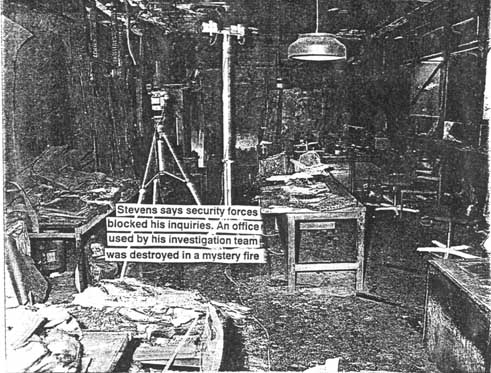
When covert attempts by British agencies like the FRU (the hiding of Nelson's paperwork at Palace barracks, the fire at Stevens' headquarters) failed, the British state could no longer completely hide its hand. The state feared the information that might be exposed during a lengthy court case so much that it had to deploy 'public' mechanisms to curtail the trial.
The cover-up had to rely on the DPP and the then Attorney General, Patrick Mayhew (a key political figure within the Thatcher government) and partial exposure of the FRU with the 'appearance' behind screens of Colonel 'J', Gordon Kerr (who remains a key military and political figure, even under Tony Blair).
The most politically dynamic revelation to come out of this period was exposure of Nelson's involvement in the Finucane killing. This became and largely remains the cutting edge of the collusion controversy. Stevens (2) was established to manage the political fallout following Nelson's trial.
Stevens (3) was established after a British Government (under international pressure to hold a public inquiry) claim that the Finucane killing had already been investigated was refuted by Stevens.
And now we have Cory.
HALF-WAY HOUSE
The British Government had fought long and hard to keep 'investigations' into allegations of collusion in-house and the appointment of a Canadian judge outside the immediate jurisdiction of the British state was a significant defeat for those who wished to keep the full horror of British state collusion under wraps.
But if Cory's investigation was no longer 'in-house' it was a half way house. Cory could only recommend a fully independent international public inquiry but he couldn't conduct one. It is hardly surprising that the Cory reports are largely a consideration of evidence already in the public arena.
Now this might have been a significant disadvantage had it not been for the fact that the entire collusion controversy has a momentum outside the British state apparatus and an enormous amount of evidence has already emerged within the public domain. Add to this a wide range of commentaries by international legal and human rights groups, politicians and lawyers, and it is clear that British state notions of collusion would most likely be swept aside, like the flotsam they always were.
The representation of collusion as something outside official sanction and support can no longer be sustained.
But while Cory does focus on collusion by omission, he also paves the way for an emerging notion of collusion by commission. Cory considers both the action and inaction of British Government agencies and significantly 'patterns of behaviour' by government agencies that indicates collusion is integral to its operation. It is here that the British state is most vulnerable to exposure. And it's the Finucane case that poses the greatest threat to the British of this kind of exposure.
FINUCANE & NELSON
In fact, the assassination of Rosemary Nelson can only really be understood
in the light of the assassination of Pat Finucane ten years previous. A
public .jpg) inquiry into the killing of Rosemary Nelson without full consideration
of the Finucane killing will necessarily be incomplete if not fatally flawed.
The British Government's decision to 'delay' the Finucane inquiry while
proceeding with an inquiry into the Rosemary Nelson killing has to be judged
in light of this.
inquiry into the killing of Rosemary Nelson without full consideration
of the Finucane killing will necessarily be incomplete if not fatally flawed.
The British Government's decision to 'delay' the Finucane inquiry while
proceeding with an inquiry into the Rosemary Nelson killing has to be judged
in light of this.
The 'delay' imposed by the British, as well as censorship of sections of report directly contravenes Cory's recommendations, to which the British Government promised to adhere. Cory specifically warns against delaying a public inquiry into the Finucane killing on the grounds of ongoing criminal prosecutions.
"This may be one of the rare situations where a public inquiry will be of greater benefit to a community than prosecutions," writes Cory.
A range of agencies were involved in the Finucane killing and the subsequent cover up. One such agency was the covert British Army unit, the FRU. FRU agent and British soldier Brian Nelson targeted the Belfast solicitor and provided intelligence to assist the killing squad.
Another FRU operative accompanied Nelson to reconnoitre Finucane's house. FRU Captain M is believed to have ordered a clear run for the killers (she had the power to remove all other British Army and RUC patrols out of the area). Captain M was directly accountable to FRU OC, then Colonel now Brigadier, Gordon Kerr.
 Special Branch was also involved in the Finucane killing. It was their
agent William Stobie who supplied the weaponry and disposed of it afterwards.
Despite information from Stobie, Special Branch did nothing to thwart the
attack or pursue the executioners.
Special Branch was also involved in the Finucane killing. It was their
agent William Stobie who supplied the weaponry and disposed of it afterwards.
Despite information from Stobie, Special Branch did nothing to thwart the
attack or pursue the executioners.
Special Branch also briefed British minister Douglas Hogg, who played a significant role in setting the scene in the run up to the killing. After the briefing, Hogg went on to describe to the British House of Commons some Belfast solicitors as unduly sympathetic to the IRA. Special Branch was also involved in covering up a taped 'confession' to the Finucane murder by UDA killer Ken Barren. Barrett was subsequently recruited as a Special Branch agent.
Special Branch doctored the evidence by replacing the confession tape and later was involved in an attempt to incriminate the CID officer Johnston Brown who had witnessed the confession and informed the Stevens team. Meanwhile, the weaponry used in the killing came from the UDR.
COLONEL 'J'
Cory considers much of this evidence while also throwing more light on the actions of government agencies like the DPP and government ministers involved in the Finucane case. Cory specifically considers Gordon Kerr's evidence during the Nelson trial and exposes his claims as fundamentally flawed if not downright lies. Kerr appeared in court behind screens and identified only as Colonel 'J'. Cory refers to Kerr as Soldier'J'.
"The evidence given by the CO FRU (soldier 'J') at Nelson's trial could only be described as misleading. The statement that Nelson's actions were responsible for saving close to 217 lives was based on a highly dubious numerical analysis that cannot be supported on any basis," says Cory.
Cory's report goes further, suggesting that Colonel 'J' not only lied in court but that there was a conspiracy to lie which involved members of the British Government and other agencies. Kerr told a senior police officer investigating the Finucane killing that he had testified from a 'script' that had been approved by others in authority. He later denied this admission.
Cory cites other evidence that supports Kerr's initial claim that he was testifying from an approved script. According to Cory, in 1990, during the first Stevens' inquiry, a senior British Government official was asked for information that might be used to persuade the Attorney General that Brian Nelson should not be prosecuted for crimes he committed while he was a FRU agent.
"A document was prepared that described Nelson's lifesaving activities in virtually the same language that was used by Soldier 'J' at Nelson's trial. This language also appeared in a letter written by the Secretary of State for Defence to the Attorney General, in which he urged the Attorney not to prosecute Nelson," says Cory.
"Whether or not this constituted a 'script', it would appear that Soldier J's testimony describing Nelson's lifesaving activities had been both approved and used by others in authority who wished to shield Brian Nelson from criminal prosecution," says Cory.
But there's more. At the time Kerr (Soldier J) gave evidence at Nelson's trial in 1992, senior officials were already well aware that the statistics referred to by 'J' were nonsense.
"In a letter sent to the Secretary of State for Defence on 25 April 1991, the Attorney General pointed out that the evidence in the possession of the DPP and others indicated that Nelson's intelligence had actually resulted in only two lives being saved and that 'the Chief Constable of the RUC agrees with this conclusion'."
In other words, the notion that Nelson's primary function was to save lives was a lie and a known lie at the time of his trial but it was used as the primary justification for the plea bargaining deal and subsequent light sentence.
The range of involvement of state agencies and government officials likely to emerge during an independent international public inquiry gives the lie to any notion of collusion as the action of individuals or of a 'rogue' unit like the FRU. It also gives the lie to the notion that state collusion takes place only on the basis of omission.
No wonder the British government is running scared and Tony Blair is 'considering' alternative forums like truth and reconciliation. A properly constituted independent public inquiry might just open up the whole squirming can of worms.
It might just reveal that British agencies like Special Branch and the FRU killed at their convenience, to cover the tracks of agents, to eliminate agents past their sell by date or uppity lawyers interfering with delivery of the criminalisation policy, loyalists who knew too much and Britain's political as well as military opponents. It might also show that they were prepared to sacrifice the lives of other British soldiers and members of the RUC.
Return to top
World Revolutionary Socialist Review
(edited extracts from a variety of anti-imperialist struggles).
GOVERNMENTS STILL INDULGING UNIONIST INTRANSIGENCE
Sinn Féin Chairperson Mitchel McLaughlin, opening the Peace Process debate on Saturday morning, told delegates that, six years after the signing of the Good Friday Agreement, the two governments have still failed to implement their key obligations and are still indulging unionist intransigence.
On the issue of arms, he questioned whether any of the other parties had used their influence, as required by the Agreement, in the positive and responsible manner that Sinn Féin had.
"How has the DUP used its unquestionable influence on, and its inextricable linkage with, Ulster Resistance? Where are its arms dumps and how many has it put beyond use? What are Peter, Gregory and Ian Paisley doing to influence those with whom they were prepared to don red berets and promise to provide 'whatever political cover was necessary'?"
"How have the Ulster Unionists used their undoubted influence with unionist paramilitaries?" he asked.
"By appointing a senior member of the party, David McNarry, to the Loyalist Commission. Well, surely the communities of the Holy Cross children and the Garvaghy Road residents deserve more than that.
Both governments clearly have the power to fulfil their obligations, he said, but instead have chosen to use it to introduce elements which are not part of the Agreement — and indeed which undermine it.
Just one example of this willingness to step outside the provisions of the Agreement, he said, was the introduction of the International Monitoring Commission, which "was introduced solely to placate rejectionist unionism".
The British Government in particular had regularly acted outside the Agreement, he added. "It unilaterally suspended the political institutions, postponed and cancelled elections, introduced draconian legislation which discourages and removes electors from the electoral register — all with the obsequious connivance of the Irish Government, which appears to act as a junior partner, subservient to the whims of a British Government."
He told delegates that Sinn Féin reaffirmed its commitment to the full implementation of the Agreement in all its aspects — including arms. "But Sinn Fern cannot implement its obligations in isolation while the two governments continue to renege on their obligations and indulge the insatiable demands of unionism in its attempts to wreck the Agreement. The patience of the republican and nationalist community is being continually dissipated," he said.
But, he continued, if one listened to the "hypocrisy and trite indignation" of the governments and leading unionists, "one could be forgiven for believing that there was only one problem with the peace process as far as they were concerned.
"Well let me make it clear — and I hope that those sections of the media that run with every comment and allegation report these facts as diligently — Sinn Féin has delivered right down to the last comma an every commitment that we have made. Sinn Féin has carried out its obligations at all times in accordance with the terms and conditions of the Agreement. Sinn Féin has never stepped outside of the Agreement."
AT last year's Ard Fheis the debate on the Peace Process centred on delegates' frustration at the lack of a proactive approach on the part of the Dublin Government; their outrage at the suspension of the institutions by the British Government and its wilful failure to live up to its obligations under the Agreement; dismay at the demand for sanctions against Sinn Féin being made by unionists; and anger about the lack of demilitarisation.
A year later, and those themes had to be revisited once again as the Review of the Good Friday Agreement — itself a response to the crisis in the Peace Process precipitated by rejectionist unionism — threatened to enter into a, subsequently realised, similarly unionist-precipitated, crisis of its own.
AS HE HAS DONE in previous years, Sinn Féin's Chief Negotiator, Martin McGuinness, provided delegates to the 2004 Ard Fheis with a detailed account of the current state of the party's negotiations with both the British and Dublin Governments and with the other political parties involved in the present political impasse.
Turning to the issue of the Review, McGuinness said that, despite the negative context in which it is set, Sinn Féin is bringing a positive attitude to it. The party has submitted a comprehensive agenda for discussion to the governments, covering a range of issues including, inter alia, equality and human rights, collusion, the failure to publish the Cory Report, electoral registration and the transfer of powers on policing and justice.
"While we have adopted a good faith approach to this review we are under no illusions with regard to its prospects," he said. "We are mindful of the inconsistency between the British Government's assertion that the Agreement cannot be renegotiated and their failure to restore the political institutions which are the democratic core of the Agreement."
"There are other issues of concern to us which we intend to raise in next week's discussions," he said. "There is the very big issue of the continuing British Government involvement in loyalist paramilitary activity. And, of course, there is ongoing concern about the DUP involvement in Ulster Resistance."
The current stalemate is a dangerous crisis he said. "But it is not a crisis that began one week ago outside a bar in Belfast. It is not a crisis around the IRA or IRA intentions. The institutions have been suspended now for almost 18 months. This is the fourth suspension. In the same period the IRA has taken a number of initiatives to move the process forward, whereas both governments, and particularly the British Government, have failed repeatedly to deliver on their commitments. In the same period the securocrats have succeeded in stalling the process of change. But that is all they have managed to do. They have not halted this process or reversed it. Nor will we allow them to."
"Sinn Féin is in this process to the end," he said. "Our intention is clear. Our intention is peaceful and democratic. Our intention is to succeed."
Despite numerous obstacles, by the time of last year's Ard Fheis, Sinn Féin had secured commitments from the governments on a range of issues, many of which were brought together in the Joint Declaration which was eventually published at the end of April.
"But let's be absolutely clear about this declaration," Martin McGuinness told delegates. "Although it deals with many of our concerns, it is a bilateral position agreed only by the two governments. It is not a Sinn Féin position. It does not and cannot supplant the Good Friday Agreement. The validity of any aspect of its content only obtains insofar as it is consistent with the Agreement."
But, he continued, although the Joint Declaration contained difficulties, "some of which were then and remain wholly unacceptable to Sinn Féin, we believed nevertheless that it committed to significant progress across a range of issues".
Consequently, the IRA leadership was persuaded to take another initiative to inject momentum into the peace process and on 13 April Gerry Adams and Martin McGuinness passed a final copy of a proposed IRA statement to the two governments. This statement contained "several highly significant and positive elements unparalleled in any previous statement by the IRA leadership".
A period of "political scrabble" followed as Tony Blair publicly raised three questions about the proposed statement, questions which were all "publicly and clearly" answered by Gerry Adams. In an attempt to break the stand-off the IRA leadership authorised a third act of putting arms beyond use.
"The UUP responded in the negative," he said. "In doing so they made it clear that their primary concern was the forthcoming election battle with the DUP and conceded that this battle would be fought on the political ground of their opponents within unionism. With unionists rejecting the IRA initiative, both governments reneged on their commitments and we were back to square one — stalemate."
Return to top